
Maintaining Stable Supply Through the Development of a Resilient Supply Chain
Supply Chain Management
Various Policies Regarding Supply Chain Management
Sysmex's Approach to Sustainable Procurement
The supply chain that supports the stable delivery of healthcare requires management under the assumption of rapid changes in the external environment, including geopolitical risks, market fluctuations, and accelerating technological innovation. In addition, a lack of consideration for human rights and the environment in raw material procurement and manufacturing processes can become a critical risk affecting corporate management, potentially leading to supply disruptions, increased costs, and reputational damage.
As a company that provides products and services essential to healthcare, Sysmex views these external uncertainties, as well as social demands regarding human rights, the environment, and compliance, as management risks. By taking forward-looking measures, we aim to balance the stable supply of products and services with sustainable value creation. At the core of this approach is the promotion of sustainable procurement.
Sustainable Procurement Structure
Sysmex has identified “Maintaining stable supply through the development of a resilient supply chain” as one of the priority issues (materiality) and is promoting risk management across the entire supply chain. This initiative is led by the Executive Officer in charge of Production and SCM under a company-wide governance framework.
Specifically, through supplier evaluations and the formulation and follow-up of corrective action plans, we identify and manage not only supply risks but also ESG risks related to human rights, the environment, and compliance. We also foster continuous dialogue and collaboration with suppliers to share challenges and provide support for improvement, thereby reducing risks and strengthening the resilience of the entire supply chain. Furthermore, we promote the greater visibility into and continuous improvement of our overall procurement activities and practice responsible procurement based on relationships of trust with suppliers. This, in turn, enhances the reliability of our products and services and leads to sustainable growth.
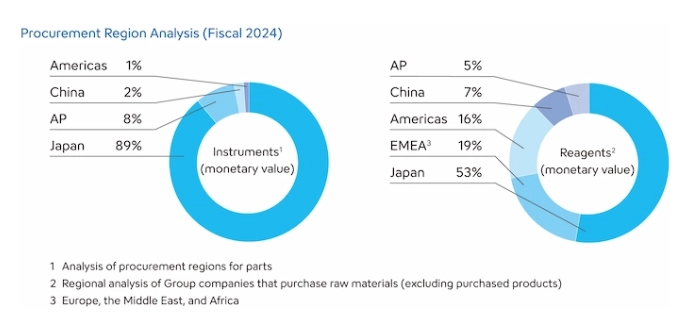 Procurement Region Analysis (Fiscal 2025)
Instruments1(monetary value)
Americas 1%
China 3%
AP 10%
Japan 85%
Reagents2(monetary value)
AP 5%
China 5%
Americas 17%
EMEA3 21%
Japan 52%
1 Analysis of procurement regions for parts
2 Regional analysis of Group companies that purchase raw materials (excluding purchased products)
3 Europe, the Middle East, and Africa
One example of our efforts to enhance supply chain management is our response to fluctuations in semiconductor supply and demand driven by the expanding demand for generative AI.
Based on lessons learned from the semiconductor supply disruptions during the COVID-19 pandemic, we shifted from a procurement model reliant on information provided by suppliers to an autonomous model in which we independently monitor and analyze market conditions. In addition to establishing direct contact with semiconductor manufacturers, we have developed a framework to capture early signs of supply-and-demand imbalances through the collection and analysis of market data, enabling us to respond before risks materialize.
As a result, for memory semiconductors, where supply shortages were anticipated due to the surge in generative AI demand, we secured sufficient inventory before procurement became difficult, thereby maintaining a stable supply of our products. Furthermore, through continuous discussions with electronic part manufacturers, we have reached agreements on securing inventory for BCP and reinforcing supply structures, further enhancing both product supply stability and the resilience of our supply chain.
Identification of Key Suppliers and Selection of New Suppliers
At Sysmex, taking into account the importance of sustainable procurement, we identify key suppliers through desk assessments (desktop assessments) that evaluate both procurement significance and ESG risks. In these assessments, we comprehensively evaluate factors such as procurement costs and difficulties in substitution with alternatives, alongside geopolitical risks, countries of origin, and competition-related risks in securing raw materials for medical product manufacturing.1 Furthermore, we assess ESG risks encompassing human rights and labor practices, chemical substances, GHG emissions, and bribery and corruption.
When selecting new suppliers, we conduct CSR surveys that include ESG criteria to verify the status of the supplier’s initiatives. We maintain a strict policy of not entering into transactions if ESG issues are identified, and we engage in dialogues with management as necessary. This approach is applied equally to overseas suppliers; in particular, regarding child labor and working environments, our procurement personnel conduct on-site visits to directly inspect and verify that no issues exist.
- 1Actions Taken in Response to Each Type of Risk:
Geopolitical risks: Procurement sources were diversified for products manufactured in Europe during the outbreak of the dispute in Ukraine, and for products manufactured in South Korea and Northern China during periods of heightened North Korean risk.
Country-of-Origin risks: Multi-country sourcing structures were established for diagnostic reagent containers and disposables.
Sector-specific risks (competing risks in securing raw materials): Alternative procurement sources were secured for glass bottles, rubber stoppers, biochemical buffering agents, raw materials for PCR, and raw materials for cultivation.
CSR Surveys of Existing Suppliers and Tier 2 Supplier Surveys
Sysmex conducts annual CSR surveys of existing Tier 1 raw material suppliers to continuously monitor their sustainability initiatives, provide feedback, and request improvements. For these CSR surveys, we use the Self-Assessment Tool Set provided by the Global Compact Network Japan to verify items such as human rights, labor practices (including occupational health and safety), corruption, and the environment. Since 2021, with the cooperation of our Tier 1 suppliers, we have expanded these surveys to Tier 2 suppliers, advancing our understanding of risks across the entire supply chain.
Our Group companies also conduct regular supplier surveys. Sysmex Europe and Sysmex America conduct sustainability surveys of all new suppliers, covering areas such as human rights and green procurement. Jinan Sysmex Medical Electronics conducts environmental and occupational health and safety surveys while holding quarterly meetings with suppliers to perform risk evaluations. Meanwhile, Sysmex Wuxi conducts periodic risk assessments of its suppliers, encouraging them to strengthen their environmental and safety management.
Results of CSR Surveys
The CSR survey conducted in fiscal 2025 for all Tier 1 raw material suppliers achieved a response rate of 95%, maintaining a high level of engagement consistent with the previous fiscal year. We also analyze the results of the CSR surveys conducted in the previous fiscal year and provide feedback to the participating suppliers. By disclosing benchmarks such as the average score of suppliers in the same raw material category, we help them identify their strengths and weaknesses. For items where risks have been identified, we encourage corrective actions and engage in ongoing dialogue and support for improvement, thereby promoting improvement initiatives together with our suppliers.
CSR On-Site Verification Audits and Promotion of Corrective and Improvement Actions
To further strengthen supplier risk management, Sysmex conducted on-site verification audits from fiscal 2022 to fiscal 2025 for 17 Tier 1 suppliers with low scores on CSR surveys. When risks are identified, we request improvements and ask suppliers to submit improvement action plans. In addition, with cooperation from Tier 1 suppliers, we expanded our CSR surveys to include Tier 2 suppliers (totaling 209 companies over the three-year period from fiscal 2023 to fiscal 2025).
When conducting these CSR surveys, we provide Tier 1 suppliers with survey formats (the GCNJ common version of CSR survey form), aggregation services, and feedback. This helps reduce their workload while allowing them to carry out the surveys efficiently.
Initiatives on Conflict Minerals
Sysmex has begun conducting conflict mineral surveys targeting raw material manufacturers that supply materials containing conflict minerals (gold, tin, tantalum, and tungsten). The SCM division is responsible for these activities and promotes responsible mineral sourcing while managing related risks through supplier surveys and risk assessments.
Ensuring the Quality of Procured Parts and Raw Materials
Sysmex presents suppliers with a quality assurance agreement that clearly states its quality requirements, ensuring that they understand its procurement policy before entering into a contract. We also regularly perform quality checks on delivered goods and conduct supplier audits to ensure that proper quality control is being carried out.
Supplier Engagement and Capability Enhancement Initiatives
Sysmex holds annual briefing sessions for its suppliers to ensure they understand its business direction and procurement policy. This helps strengthen its relationships with suppliers while promoting sustainability activities.
In fiscal 2023, we held a procurement policy briefing to introduce our newly formulated long-term corporate strategy, supply chain management policy, and Eco-Social Strategy. The event was well-attended by approximately 500 participants from around 250 suppliers. In fiscal 2024, we organized a briefing session on our SBT (Science Based Targets) initiatives, alongside a briefing session focusing on the importance and practice of calculating greenhouse gas (GHG) emissions, promoting efforts to reduce CO2 emissions across the entire supply chain. In fiscal 2025, we conducted a briefing session on methods for calculating GHG emissions and obtained primary data from 51 suppliers. By visualizing GHG emissions across the entire supply chain, we are driving forward initiatives aimed at reducing emissions.
Our overseas Group companies also engage in regular dialogue with suppliers and sales distributors to share challenges related to quality, the environment, and compliance, advancing improvement initiatives. Through these activities, we strive to maintain and improve sustainability and stable supply throughout the entire supply chain.
Promoting Responsible Procurement and Logistics
Sysmex is committed to promoting fair and proper transactions with suppliers while working to ensure compliance with laws and regulations related to procurement and logistics and giving due consideration to working environment across the supply chain.
Fair Transactions and Compliance with Procurement-Related Laws and Regulations
Sysmex uses an electronic procurement system to enhance transparency throughout the procurement process, promoting fair transactions. In October 2020, we announced the Partnership Building Declaration to increase added value across the entire supply chain.
Furthermore, we comply with the Subcontract Act and relevant laws and guidelines, including promotion standards based on the Act on the Promotion of Subcontracting Small and Medium-sized Enterprises, to ensure fair and appropriate business practices between purchasers and suppliers. We also work to correct trade and business practices that hinder the establishment of strong partnerships with our suppliers.
Training for Employees Involved in Procurement
Sysmex works to improve understanding of legal compliance and fair transactions among employees involved in procurement.
In fiscal 2025, we provided training on the revised subcontracting-related laws and regulations to procurement division personnel as well as managers and staff responsible for fair business transactions in each division at domestic Group companies.
Furthermore, we offer training related to the Partnership Building Declaration and the roles of companies placing orders in CSR activities to Procurement division personnel. We also provide training on our procurement policy, CSR procurement, and procurement risks to newly assigned employees, aiming to enhance knowledge and awareness for promoting appropriate procurement activities. We also conduct regular internal reviews to ensure that procurement activities do not undermine compliance with ESG requirements. Based on the results of these reviews, we implement operational improvements and provide training to relevant personnel, thereby promoting sustainable and responsible procurement activities.
Optimizing Working Hours and Improving Working Environment in Logistics
Following the enforcement of the Work Style Reform Law for transportation and logistics work on April 1, 2024, Sysmex discontinued same-day shipping for same-day orders of ambient-temperature reagents and consumables, shifting to a next-day shipping model.1 This change has helped reduce truck drivers’ waiting time for loading, which previously contributed to the overwork of truck drivers.
We have also mechanized the handling of heavy loads to improve the working environment for warehouse workers and have conducted surveys on respect for human rights, thereby proactively addressing the so-called “2024 problem” in logistics.
Furthermore, in response to the amendments to subcontracting-related laws and regulations (including the expansion of their scope of application), which took effect on January 1, 2026, we have strengthened our compliance in transactions with transportation service providers by ensuring clear order specifications and establishing appropriate payment due dates. Through these initiatives, we strive to achieve a sustainable working environment in logistics while maintaining a stable supply.
- 1Products other than ambient-temperature reagents and consumables, such as refrigerated reagents and instruments, have long been handled on a same-day order, next-day shipment basis.