
Environmental Management
Sysmex Eco-Vision 2033
Establishment of Sysmex Eco-Vision 2033
In May 2023, Sysmex formulated “Sysmex Eco-Vision 2033.” This is the long-term environmental vision that the Sysmex Group strives to achieve by 2033, in which we will take on the challenges of green innovation together with our stakeholders and utilize Sysmex’s unique strengths to co-create new standards for a circular society. Furthermore, we have set new “Carbon Neutral Targets” with the aim of achieving net zero emissions of greenhouse gases from the business sites of the entire Sysmex Group by 2040.1 We will continue to promote optimization of our operations and energy-saving measures. At the same time, we will implement measures to reduce greenhouse gas emissions, including a gradual switching to renewable energy-sourced electricity at our business sites.
- 1Applies to Scope 1 emissions, which are direct emissions of greenhouse gases from fuel consumption by the company, and Scope 2 emissions, which are indirect emissions of greenhouse gases from the consumption of electricity and heat purchased by the company
Long-Term Environmental Vision
 Long-Term Environmental Vision
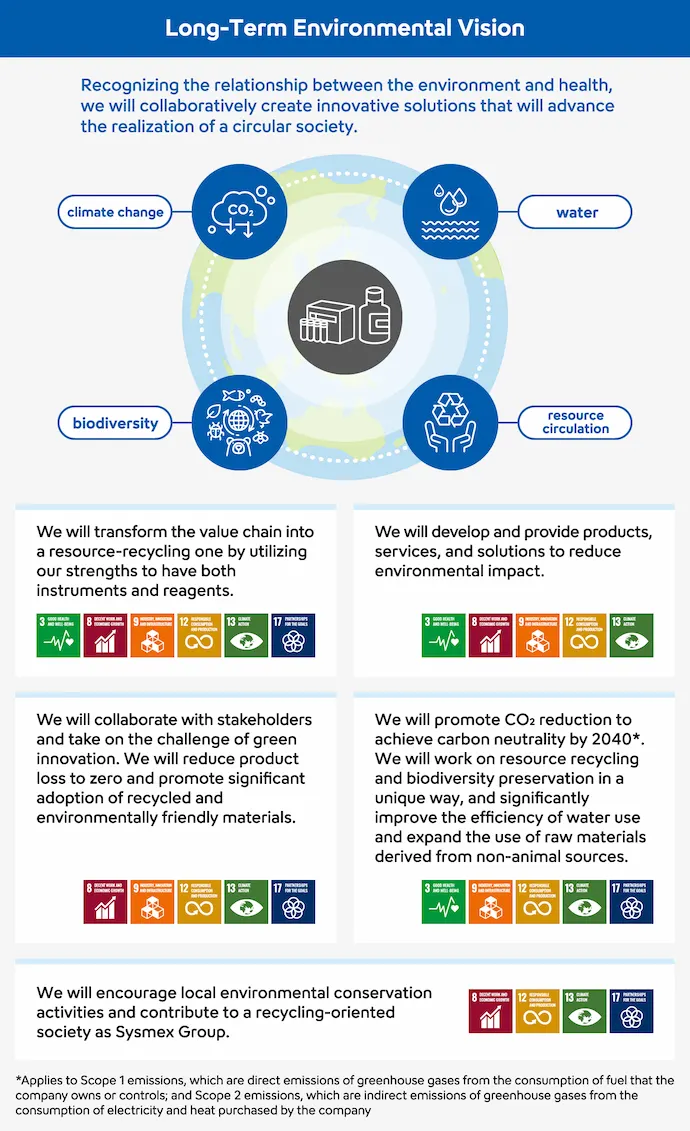
Recognizing the relationship between the environment and health, we will collaboratively create innovative solutions that will advance the realization of a circular society.
The vision focuses on four environmental themes: climate change, water, biodiversity, and resource circulation.
We will transform the value chain into a resource-recycling one by utilizing our strengths to have both instruments and reagents.
We will develop and provide products, services, and solutions to reduce environmental impact.
We will collaborate with stakeholders and take on the challenge of green innovation. We will reduce product loss to zero and promote significant adoption of recycled and environmentally friendly materials.
We will promote CO₂ reduction to achieve carbon neutrality by 2040*. We will work on resource recycling and biodiversity preservation in a unique way, and significantly improve the efficiency of water use and expand the use of raw materials derived from non-animal sources.
We will encourage local environmental conservation activities and contribute to a recycling-oriented society as Sysmex Group.
*Applies to Scope 1 emissions, which are direct emissions of greenhouse gases from the consumption of fuel that the company owns or controls; and Scope 2 emissions, which are indirect emissions of greenhouse gases from the consumption of electricity and heat purchased by the company.
Long-Term Environmental Objectives
 Long-Term Environmental Objectives
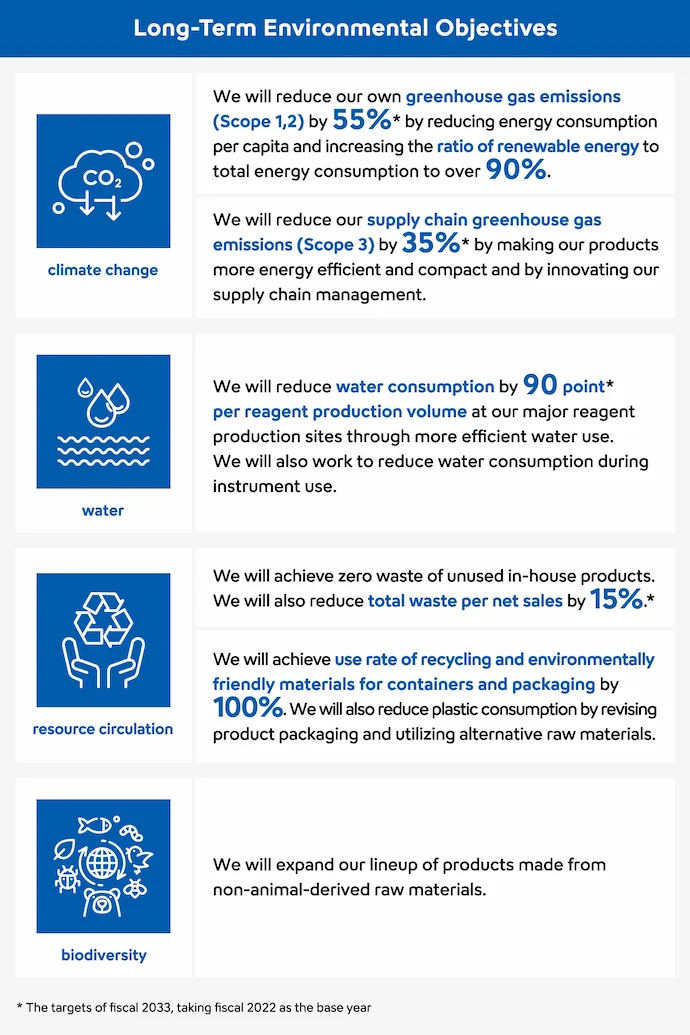
climate change
We will reduce our own greenhouse gas emissions (Scope 1,2) by 55%* by reducing energy consumption per capita and increasing the ratio of renewable energy to total energy consumption to over 90%.
We will reduce our supply chain greenhouse gas emissions (Scope 3) by 35%* by making our products more energy efficient and compact and by innovating our supply chain management.
water
We will reduce water consumption by 90 point* per reagent production volume at our major reagent production sites through more efficient water use.
We will also work to reduce water consumption during instrument use.
resource circulation
We will achieve zero waste of unused in-house products. We will also reduce total waste per net sales by 15%.*
We will achieve use rate of recycling and environmentally friendly materials for containers and packaging by 100%. We will also reduce plastic consumption by revising product packaging and utilizing alternative raw materials.
biodiversity
We will expand our lineup of products made from non-animal-derived raw materials.
* The targets of fiscal 2033, taking fiscal 2022 as the base year
Accreditation of Near-Term Target from SBTi
Sysmex has been approved by the Science Based Targets initiative (SBTi), an international initiative working to overcome the environmental crisis on the basis of climate science, for the Groupʼs fiscal 2033 greenhouse gas reduction target.
As part of Sysmex Eco-Vision 2033, Sysmex has set reduction targets for its own GHG emissions (Scope 1 and 2) and its supply chain GHG emissions (Scope 3). Among these targets, the Companyʼs target to reduce its Scope 1 and 2 emissions by 55% was found to be based on scientific evidence in line with a 1.5°C trajectory, while its target to reduce GHG emissions from use of sold products under Scope 3 by 35% was found to be well below the 2.0°C level.
Furthermore, our newly established engagement goal was recognized as a commitment to encouraging 60% of our suppliers involved in Scope 3 categories, including purchased goods and services, capital goods, and upstream and downstream transportation and distribution, to have science-based GHG reduction targets within five years.
With global GHG emissions reduction still falling short of the 1.5°C target of the Paris Agreement, further changes in social expectations are anticipated. Viewing its SBTi certification as a key opportunity, Sysmex will continue pursuing CO2 emission reductions by changing energy procurement at its business sites and in its sales and service operations while promoting resource recycling by adopting environmentally friendly materials in its products. We will further promote our decarbonization efforts by implementing green innovation based on the ingenuity built by combining the wisdom of the entire Group.
Information Disclosure Based on TCFD・TNFD
Since its endorsement of the TCFD recommendations in 2021, Sysmex has been working on climate change initiatives under its Sysmex Eco-Vision 2033. In July 2025, we endorsed the TNFD recommendations, which aim to promote nature-related risk management and information disclosure, and registered as a TNFD Adopter. By taking an integrated view of issues related to climate change and natural capital and advancing comprehensive evaluation of risks and opportunities, we will strengthen sustainable initiatives based on resource conservation and resource circulation, balancing positive impacts on our business activities with the preservation of the natural environment.
General Requirements Based on TNFD Recommendations
- Application of Materiality
In addition to Sysmexʼs materiality, which is defined from the perspective of impact on both social and corporate value, we have adopted double materiality that takes into account dependencies and impacts related to climate change and natural capital.
- Scope of Disclosure
We evaluate risks and opportunities by covering not only the Sysmex Groupʼs business activities but also the entire value chain. For natural capital, priority evaluation targets are selected based on production volumes in our business activities, as well as resource use and emissions in terms of dependencies and impacts (to be expanded in due course).
- Regions with Nature-related Issues
In accordance with the definition of areas requiring attention, we assess our business sites, including adjacent areas, using the biodiversity risk evaluation tool “WWF Biodiversity Risk Filter” and the water risk evaluation tool “Aqueduct,” along with our own environmental performance data. Monitoring is continuously conducted in collaboration with local sites.
- Integration with Other Sustainability Issues
Since climate change and natural capital mutually influence one another, we adopt an integrated approach with the disclosures already made under the TCFD.
- Time Frames
The time frames for the manifestation of risks remain unchanged: short-term, 1 year; medium-term, up to 3 years; and long-term, up to 10 years.
- Regional Engagement
Based on our Human Rights Policy, we position considerations for the environment as part of the Companyʼs overall responsibility. In natural capital evaluation, we conduct communication with local governments and other stakeholders in areas surrounding our business sites to confirm and understand the environmental impacts on these regions.
Governance
Sysmex promotes initiatives to address environmental issues such as climate change and natural capital through the Environmental Management Committee, which meets regularly under the management and supervision of the Environmental Management Officer (Takashi Ono, Director and Managing Executive Officer). The status of activities against plans and important matters are discussed and decided at management meetings, such as the Steering Committee meetings, under the supervision of the Board of Directors.
Strategy
Taking into account integrated scenarios1 under the TCFD and TNFD, which reflect the interrelationship between climate change and natural capital, as well as the Eco-Social Strategy, which is the basic strategy for our long-term corporate strategy, Sysmex re-evaluated risks and opportunities across all Group businesses2 in 2025. The financial impact of risks and opportunities was evaluated in three stages, based on their potential impact on operating profit in fiscal 2033. Regarding natural capital, Sysmex applied the LEAP approach3 recommended by the TNFD to evaluate dependencies and impacts, identifying “freshwater” and “soil” as natural capital to be recognized. We are strengthening our initiatives toward the conservation and sustainable use of these resources.
- 1External scenario tools used: AR6 (SSP1-1.9, SSP5-8.5), The IPR FPS + Nature, IEA (STEPS, NZE), Aqueduct Water Risk Atlas.
- 2The scope of analysis covers the entire supply chain, including not only our own operations but also upstream activities (such as raw material procurement and outbound logistics) and downstream activities (such as product use).
- 3A nature-related risk and opportunity evaluation framework recommended by the TNFD. Evaluation is conducted across four stages: Locate (interface with nature), Evaluate (dependencies and impacts), Assess (risks and opportunities), and Prepare (responses and disclosure).
- Implementation of the LEAP Approach Evaluation
Sysmex conducted an evaluation based on the LEAP approach recommended by the TNFD.
From both internal and external perspectives, we mapped environmental impacts across the product value chain in our diagnostics business, taking into account our business model, sales composition ratio, and Sustainable Industry Classification System (SICS). After reviewing the geographic information of business sites, we cross-referenced our findings with ENCORE, the SBTN Materiality Screening Tool, and the High Impact Commodity List.
For regional risk evaluation, we utilized the Biodiversity Risk Filter and Aqueduct to identify regions where natural capital could be significantly impacted, extracting freshwater and soil as priority areas of risks and opportunities.
Furthermore, based on the integrated TCFD and TNFD scenarios, we used two quadrants of different temperature ranges and worldviews to assess future impacts. Through discussions with relevant divisions based on the results, we confirmed and organized the relationship between business activities and natural capital in priority regions.
Going forward, we will expand the scope of regions subject to evaluation and strategically advance initiatives that contribute to the preservation and restoration of natural capital (freshwater and soil).
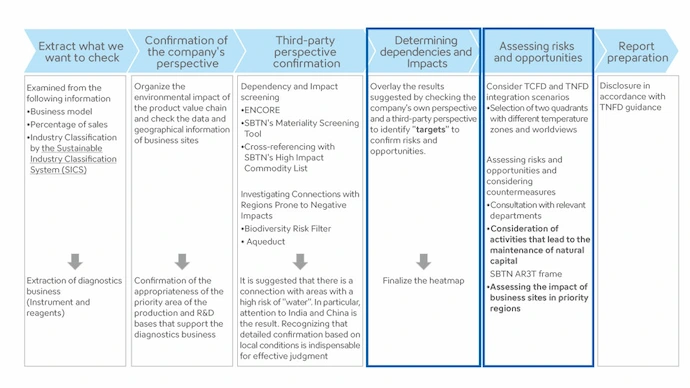 Extract what we want to check
Examined from the following information
• Business model
• Percentage of sales
• Industry Classification by the Sustainable Industry Classification System (SICS)
Extraction of diagnostics business (Instrument and reagents)
Confirmation of the company's perspective
Organize the environmental impact of the product value chain and check the data and geographical information of business sites
Confirmation of the appropriateness of the priority area of the production and R&D bases that support the diagnostics business
Third-party perspective confirmation
Dependency and Impact screening
• ENCORE
• SBTN's Materiality Screening Tool
• Cross-referencing with SBTN's High Impact Commodity List
Investigating Connections with Regions Prone to Negative Impacts
• Biodiversity Risk Filter
• Aqueduct
It is suggested that there is a connection with areas with a high risk of "water". In particular, attention to India and China is the result. Recognizing that detailed confirmation based on local conditions is indispensable for effective judgment
Determining dependencies and Impacts
Overlay the results suggested by checking the company's own perspective and a third-party perspective to identify "targets" to confirm risks and opportunities.
Finalize the heatmap
Assessing risks and opportunities
Consider TCFD and TNFD integration scenarios
• Selection of two quadrants with different temperature zones and worldviews
Assessing risks and opportunities and considering countermeasures
• Consultation with relevant departments
• Consideration of activities that lead to the maintenance of natural capital
SBTN AR3T frame
• Assessing the impact of business sites in priority regions
Report preparation
Disclosure in accordance with TNFD guidance
- Identification of Dependencies and Impacts
For the identified target areas, we organized and evaluated the presence and magnitude of our dependencies on natural capital and the impacts of our business activities from both internal and external perspectives.
■Materiality Evaluation (Heat Map)
| Instrument | Reagent | |||
|---|---|---|---|---|
| Dependence | Soil | Soil protection / Erosion prevention | - | Middle |
| Freshwater | Groundwater | - | High | |
| Surface water | - | - | ||
| Water cycle | - | Middle | ||
| Ecosystem | Genetic material | - | - | |
| Impact | Resource utilization | Water use | - | High |
| Pollution | Air pollution | - | - | |
| Soil pollution | Middle | Middle | ||
| Solid waste | Middle | Middle | ||
| Water pollution | Middle | Middle | ||
| Obstruction | Noise and light pollution | - | - | |
- Evaluation of Risks and Opportunities
Based on the analysis of dependencies and impacts, we evaluated risks and opportunities, using two future scenarios that integrate natural capital and climate change, and examined appropriate response measures. Toward achieving nature-positive outcomes, we organized our activities that contribute to the preservation of natural capital in accordance with the AR3T1 framework for natural capital recommended in the SBTs for Nature (SBTN).
- 1An action framework for nature-related risks recommended by the TNFD. Countermeasures are considered based on a hierarchy of priorities: Avoid, Reduce, Restore & Regenerate, and Transform.
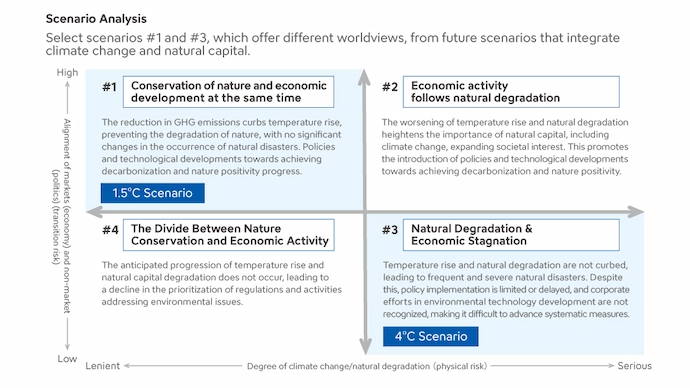 Scenario Analysis
Select scenarios #1 and #3, which offer different worldviews, from future scenarios that integrate climate change and natural capital.
High
Low
Alignment of markets (economy) and non-market (politics) (transition risk)
#1
Conservation of nature and economic development at the same time
The reduction in GHG emissions curbs temperature rise, preventing the degradation of nature, with no significant changes in the occurrence of natural disasters. Policies and technological developments towards achieving decarbonization and nature positivity progress.
1.5°C Scenario
#2
Economic activity follows natural degradation
The worsening of temperature rise and natural degradation heightens the importance of natural capital, including climate change, expanding societal interest. This promotes the introduction of policies and technological developments towards achieving decarbonization and nature positivity.
#4
The Divide Between Nature Conservation and Economic Activity
The anticipated progression of temperature rise and natural capital degradation does not occur, leading to a decline in the prioritization of regulations and activities addressing environmental issues.
#3
Natural Degradation & Economic Stagnation
Temperature rise and natural degradation are not curbed,leading to frequent and severe natural disasters. Despite this, policy implementation is limited or delayed, and corporate efforts in environmental technology development are not recognized, making it difficult to advance systematic measures.
Lenient
Serious
Degree of climate change/natural degradation (physical risk)
- Risks and Opportunities
As a result of the evaluation, we identified the following as particularly material risks: increased energy, raw material, and logistics costs; reduced competitiveness due to changing environmental awareness among customers; and the impact on product supply caused by large-scale natural disasters. On the other hand, we recognized opportunities such as increased efficiency in logistics and product design, resource savings in packaging and containers, and growing demand for environmentally friendly products and services.
Risks Related to Environmental Issues
Risk Category Possible Risks Impact Period1
Financial ImpactInitiatives Transition Risks Policy Climate change
Natural capitalChanges in regulations may restrict the use of certain raw materials or technologies, making it difficult to supply products or requiring the use of costly alternatives. Mid to long term
LowEstablish QA/RA divisions at each regional headquarters to respond to regulatory changes.
Conduct regular risk assessments of raw materials and ensure a stable supply by considering switching to alternative raw materials.Market Climate change Energy and raw material costs, as well as global logistics costs, will increase. Short to long term
HighReduce energy costs through the introduction of renewable energy, energy-saving measures, and improving equipment efficiency, alongside expanding the scope of concentrated reagent products with high transportation efficiency and developing a borderless logistics network. Technology Climate change
Natural capitalShifting to materials and technologies with low environmental impact will lead to an increase in R&D costs and capital investment.
It will be difficult to commercialize products that comply with environmental regulations at the expected timing.Mid to long term
LowPromote the development of products and technologies based on laws and regulations, customer requirements, and market and industry trends while systematically transitioning to environmentally friendly materials. Reputation Climate change
Natural capitalChanges in customers’ environmental awareness will lead to criticism of the environmental impact of our products, resulting in decreased demand and reduced competitiveness. Mid to long term
HighPromote environmentally conscious planning and design and technology and product development by using a Voice of the Customer (VOC) system, which incorporates customer feedback into product development and quality improvements, as well as by developing reagent containers suitable for closed-loop recycling. Physical Risks Acute Climate change
Natural capitalLarge-scale natural disasters can cause damage to factories and disruptions in supply chains, making it difficult to provide a stable supply of products. Short to long term
HighDiversify risks by building a distributed production system in the vicinity of consumption areas, based on the Business Continuity Plan (BCP), alongside securing multi-sourcing supply systems, alternative transport routes, and safety stock for raw materials. Chronic Climate change
Natural capitalRegional shortages of water due to drought will disrupt the stable supply of products. Mid to long term
MiddleReduce risks by periodically monitoring water-related risks and establishing BCPs.
- 1Short term: 1 year; Medium term: Up to 3 years; Long term: Up to 10 years
Opportunities Related to Environmental Issues
| Opportunity / Category | Potential Opportunities | Impact Period1 Financial Impact | Initiatives |
|---|---|---|---|
| Resource Efficiency | |||
| Climate change | The use of more efficient transportation methods and the application of IoT will optimize operations. | Short to long term High | Promote CO2 reduction through the digitalization of global logistics processes, the provision of remote services, and the digital conversion of product-related information such as package inserts and display values. |
| Climate change Natural capital | Review of packaging and product design will lower raw materials costs and waste. | Short to long term High | Reduce waste and recycle resources by conserving resources through revised packaging materials and formats, transitioning to plastic-free materials, expanding the scope of dry ice-free ultralow-temperature transportation, reducing product loss to zero, and converting resources generated during manufacturing and development processes into valuable resources. |
| Energy | |||
| Climate change | Energy saving will reduce energy costs, and a shift toward low-carbon energy sources will improve corporate reputation. | Mid to long term Low | Reduce energy consumption through energy-saving measures, improved equipment efficiency, the introduction of renewable energy, the acquisition of ZEB certification, the transition of company vehicles to fuel-efficient models, and the promotion of replacement of existing products with high power consumption. |
| Products & Services | |||
| Climate change Natural capital | Changes in long-term disease trends due to environmental degradation will create new testing opportunities and expand demand for testing. | Mid to long term Middle | Promote the development of products that contribute to combating infectious diseases, such as malaria and antimicrobial resistance (AMR), while promoting initiatives to strengthen collaboration with public health policies, using digital technologies. |
| Market | |||
| Climate change Natural capital | Changes in customer purchasing preferences will create opportunities to develop new products and services, driven by increased demand for environmentally friendly products and products that can be used both in normal and emergency situations. | Mid to long term Middle | Promote the development of energy-saving and miniaturized products, circular economy products that leverage energy- and resource-saving technologies, and diagnostic reagents with extended shelf lives. |
| Reputation | |||
| Climate change Natural capital | Initiatives on climate change and natural capital and information disclosure will increase our evaluation and expectations in financial markets. | Short to mid term Low | Disclose environmental information through alignment with the TCFD and TNFD frameworks, as well as the Sysmex Sustainability Data Book. |
| Resilience | |||
| Climate change Natural capital | A stable supply of products and services in the event of a natural disaster will improve customer trust. | Mid to long term Middle | Establish a global supply structure and a backup system through multi-sourcing of raw materials. |
- 1Short term: 1 year; Medium term: Up to 3 years; Long term: Up to 10 years
- Activities that lead to the maintenance of natural capital (freshwater and soil)
SBTN AR3T Classification1 Maintenance of Water Resources Maintenance of Soil Function Avoid - - Review of materials and formats related to containers and packaging
- Application of FSC-certified paper to reagent packaging boxes
- Digitization of product-related information such as package inserts and display values
Reduce - Expansion and distributed production of concentrated reagent products
- Reduction of water consumption in the production processes
- Zero product loss (recycling of unused products)
- Extension of reagent shelf life
Regenerate / Restore - - Development of reagent containers suitable for closed-loop recycling
- Conversion of resources generated during production and development processes into valuable resources
Transform Development of environmentally friendly technologies and green innovation products
- 1SBTN AR3T: The Science Based Targets Network’s action framework (Avoid, Reduce, Regenerate, Restore, and Transform)
Management of Risks and Impacts
As part of the company-wide risk management structure, the Internal Control Committee is organized under the Board of Directors and the President, with the Environmental Management Committee positioned as one of its subordinate bodies. The Environmental Management Committee reviews environmental risks and opportunities, including those related to climate change, twice a year, and it assigns necessary initiatives to relevant divisions. The Committee also monitors the progress of these initiatives.
From a mid- to long-term perspective, the Environmental Management Committee identifies significant environmental risks with potential large impacts on business every few years and implements countermeasures. The results are reported at management meetings, chaired by the President, and are incorporated into company-wide risk assessment led by the Internal Control Committee.
Metrics & Targets
Sysmex has set forth Sysmex Eco-Vision 2033 and sustainability targets to advance the non-financial targets defined in the “Declaration of Achieving Carbon Neutrality by 2040”1 and in the Long-Term Corporate Strategy, which runs through fiscal 2033.
Natural capital-related metrics and targets reflect the evaluation results obtained through the LEAP approach in line with the TNFD recommendations. These are integrated into the Company’s overall non-financial target framework and are centrally managed together with other environmental targets.
Specifically, as climate change targets, Sysmex aims to reduce greenhouse gas (GHG) emissions. For natural capital, our targets include reducing water consumption per unit of reagent production at major reagent production bases, achieving zero product loss (maintaining the disposal rate of unused Sysmex products below 0.1%), and transitioning completely to recycled and environmentally friendly materials. We continue advancing a wide range of initiatives across all stages of the product lifecycle—from R&D through production, logistics, and disposal.
Furthermore, GHG emission reduction targets and other objectives based on our Eco-Vision are cascaded to the objectives of relevant divisions, managers, and employees. Achievement levels are reflected in compensation such as bonuses, and organizations or individuals delivering exceptional results are recognized through internal award systems.
- 1Targeting net zero greenhouse gas emissions from Group business sites by 2040 (Scope 1 and Scope 2)
Evaluation Process and Results
Sysmex recognizes considerations for natural capital, including water, forests, and soil, to be essential alongside climate change countermeasures, and it pursues an integrated approach to these challenges.
Specifically, based on the recommendations of the TNFD, we identified freshwater and soil as key natural capital resources where our business activities have significant dependencies and impacts on natural capital. We also evaluate the environmental impact in the regions where our business sites are located, alongside our initiatives toward appropriate resource use and their effectiveness.
In the first year, we conducted surveys targeting three sites in Japan, where resource usage and production scales are substantial. In fiscal 2025, we carried out similar surveys at two sites in Europe with stringent environmental regulations and high market expectations. These evaluations revealed no adverse environmental impacts on the surrounding areas. In the future, we plan to gradually increase the number of sites we evaluate.
Impact Assessment of Two Sites in Europe
| Site | Major dependencies and impacts | Impact on the local communities | |
|---|---|---|---|
| Sysmex Europe Neumünster Factory (Neumünster, Germany) | Freshwater | Use and discharge of water resources | Compared to the amount of water distributed by the municipality, the impact of our use on the community is limited. Activities to reduce water consumption in the manufacturing process are being promoted. |
| Soil | Use of plastic containers | Compared to the total amount of plastic materials produced in Germany, plastic material usage is extremely limited. The use of environmentally friendly alternatives for packaging materials is promoted. | |
| Sysmex Europe Headquarters1 (Norderstedt, Germany) | Soil | Waste emissions | Ongoing communication is maintained with relevant authorities through reporting and consultations led by waste management representatives. |
- 1For Sysmex Europe Headquarters, the assessment covers the most recent one-year period prior to its relocation in fiscal 2025.
Impact Assessment of Three Sites in Japan
| Site | Major dependencies and impacts | Impact on local communities | |
|---|---|---|---|
| Technopark (Kobe City, Hyogo Prefecture) | Freshwater | Use of groundwater | No adverse effects on the surrounding area, such as land subsidence, have been confirmed due to its use. A continuous monitoring system has been established to ensure proper management of water resources and reduce water consumption, including reporting to the City of Kobe every two months. |
| Ono Factory (Ono City, Hyogo Prefecture) | Freshwater | Use and discharge of water resources | Compared to the amount of water distributed by the municipality, the impact of our use on the community is limited. The annual water use and discharge tend to decrease. |
| Soil | Use of plastic containers | Compared to the total amount of plastic materials produced in Japan, the amount used is extremely small, and the impact on the environment is limited. Further reduction in consumption is expected through closed-loop recycling and substitution with environmentally friendly materials. | |
| i-Square (Kakogawa City, Hyogo Prefecture) | Soil | Use and disposal of metals (iron) | Compared to the total amount of iron produced in Japan, the impact of our use on the environment is limited as the usage is negligible. A high level of resource efficiency is achieved through a recycling rate of 96% and the conversion of waste materials into valuable resources. |
Environmental Management System
Group Environmental Management System
Promoting ISO 14001 Certification
Sysmex is promoting the acquisition of ISO 14001 certification, the international standard for environmental management systems, across major Group companies.
As of the end of March 2026, 21 Group companies had obtained ISO 14001 certification, and these companies account for approximately 72% of the net sales of the Group.
Furthermore, Sysmex Corporation, Sysmex RA, and Sysmex Medica1 have obtained integrated certification covering nine sites across the three companies. Through this integrated certification, the companies continuously implement the systematic sharing of information related to environmental management and streamlining management processes.
List of ISO 14001 Certified Locations
| Region | Company |
|---|---|
| Japan | Sysmex Corporation (including Sysmex Medica), Sysmex RA |
| Americas | Sysmex America, Sysmex Reagents America, Sysmex Brazil |
| EMEA1 | Sysmex Europe, Sysmex Deutschland, Sysmex France, Sysmex Espana, Sysmex UK, Sysmex Belgium, Sysmex Nederland, Sysmex Nordic, Sysmex Hungaria, Sysmex Portugal |
| China | Sysmex Wuxi, Jinan Sysmex |
| AP | Sysmex Asia Pacific, Sysmex India, Sysmex Australia |
- 1EMEA: Europe, the Middle East, and Africa
Conducting Environmental Audits
In line with the requirements of the environmental management system, Sysmex performs regular internal and external environmental audits at business sites that have obtained ISO 14001 certification. In fiscal 2025, there were zero cases of nonconformities in both internal environmental audits and external environmental audits at business sites covered by integrated certification.
Environmental Education
Conducting Environmental Education and Training
Sysmex conducts general education for all employees to foster awareness of the Groupʼs environmental activities and the environmental impacts of their daily operations. We also provide specialized training for leaders and staff responsible for promoting environmental management systems in each division to help them acquire practical knowledge. Additionally, individual divisions conduct specialized training and emergency response drills as needed.
In fiscal 2025, we continued to provide general environmental e-learning training for all employees at our business sites covered by integrated ISO certification. We also held seminars on laws and regulations for representatives of business sites and personnel in the product lifecycle divisions.