Stable Supply of Products
We position diagnostic reagents, which are essential for maintaining testing, to be highly critical for business continuity. Based on the principle of never interrupting testing in healthcare facilities under any circumstances, we have established a stable supply system for diagnostic reagents through our bases around the world.
By securing safety stocks of raw materials and products in each region in advance to respond to emergencies, we are prepared to continue supplying products to healthcare facilities even if our factories or warehouses are hit by a disaster. Specifically, we have not only established the following six fundamental principles as rules, but have also been implementing business continuity activities by presenting concrete measures and procedures through guidelines.
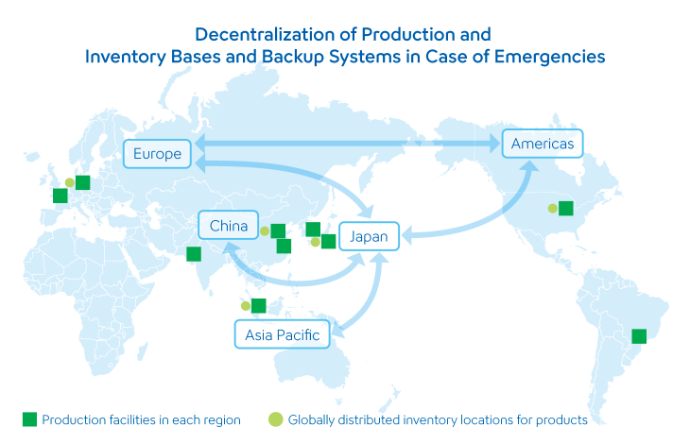
1) Global decentralization of diagnostic reagent production facilities
We are systematically transferring production of our main diagnostic reagent products to factories located near sales regions, establishing a local production and consumption model.
This will help ensure a stable supply by diversifying supply risks, and by shortening transportation lead times, it will enable us to provide products with longer usable periods. Furthermore, global decentralization contributes to reducing environmental impact, such as reducing CO2 emissions.
2) Strengthening the resilience of diagnostic reagent production facilities
Establishing a production transfer system in advance to prepare for disasters enables rapid alternative production at other locations even if some plants are damaged.
Furthermore, each factory is working to minimize the risk of operational shutdowns during disasters and to achieve early recovery by implementing measures such as diversifying production lines, strengthening earthquake-resistant and disaster prevention measures for equipment, securing emergency power sources, developing disaster response manuals, and conducting training.
3) Securing a continuous supply of raw materials and promoting procurement from multiple suppliers
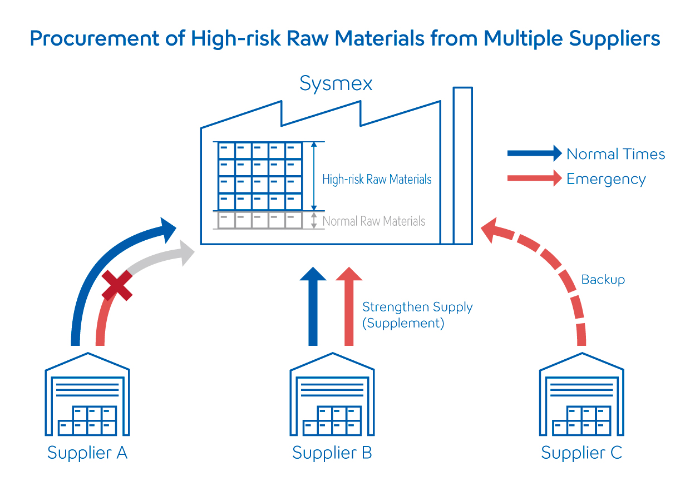
We maintain safety stock levels commensurate with their risk characteristics even in normal times. We also maintain sufficient Business Continuity Plan (BCP) stocks for high-risk raw materials to ensure that supply can continue even if our suppliers are affected by a disaster.
For essential raw materials that are difficult to substitute, we are working to reduce reliance on a single source by diversifying procurement across multiple sources and implementing backup production in cooperation with suppliers.
4) Securing safety stocks of products and storing them at multiple locations
We secure appropriate inventory levels of diagnostic reagent products at each base, and are prepared to continue supplying them for a certain period (generally one month or longer) even if production is temporarily suspended. We thoroughly manage expiration dates and administers proper inventory management.
Furthermore, we have globally distributed inventory locations of service parts and centrally manages a wide variety of parts using an inventory management system, making it possible to provide rapid maintenance services even in the event of equipment failure.
5) Establishment and strengthening of logistics networks
We have developed manuals outlining alternative transportation routes and procedures in case normal transportation routes are disrupted due to disasters or geopolitical risks. We have established a structure where information on alternative airports and ports, as well as import permits and licenses, is shared in each region, and a switch to alternative transportation routes is enabled rapidly as needed.
6) Mutual supply in preparation for greater impacts
In cases where the impact of a disaster is huge and it is difficult for the affected area to maintain supply on its own, we will leverage our strengths in global production and supply networks to supplement supply to the affected area by providing not only mutual supply within the region but also, for main products, cross-regional product supply (global mutual supply).