
Resource Circulation in Product Lifecycle
Product Lifecycle and Initiatives at Each Stage
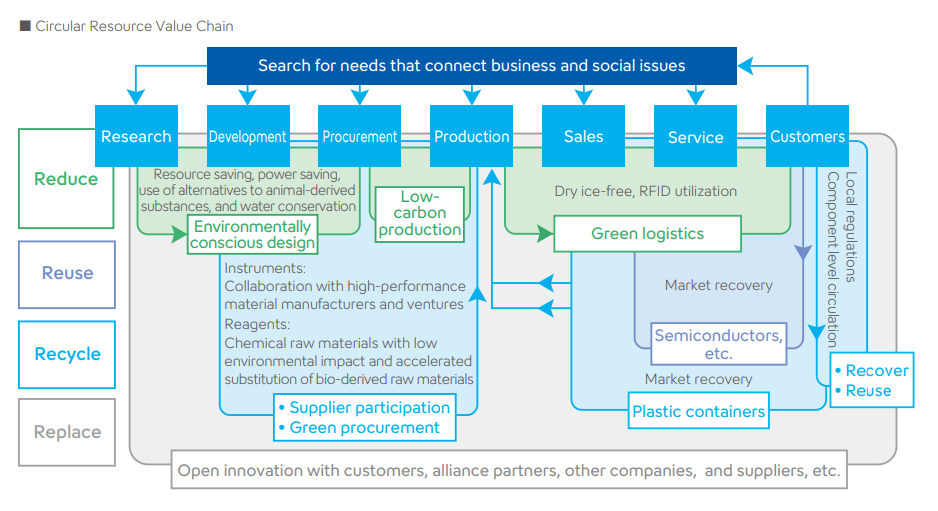
Sysmex undertakes a variety of initiatives at all stages of its business activities to reduce environmental impact throughout the product lifecycle, with a focus on dependencies and impacts. Since fiscal 2023, under our Eco-Social Strategy, which is one of the core strategies in our long-term corporate strategy, we have been promoting further initiatives toward the realization of a circular resource value chain, in addition to our existing activities.
Environmentally Conscious Research and Development
Energy Saving and Miniaturization of Products
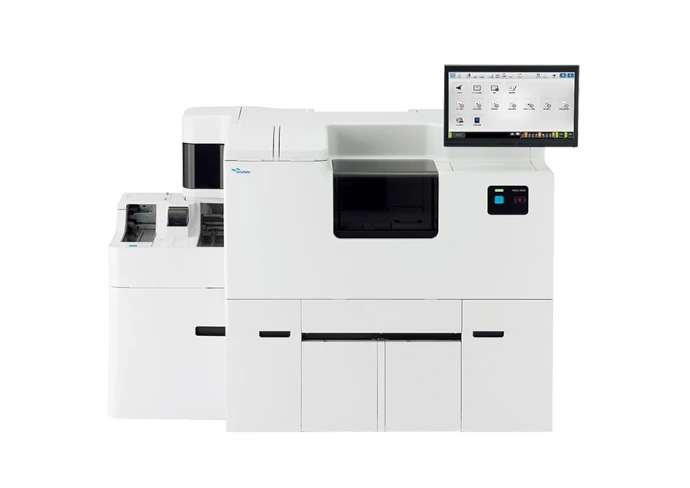
To help customers reduce energy use and waste during product use, Sysmex has incorporated environmentally responsible practices considered appropriate from a management perspective for each stage of the product lifecycle into its global product lifecycle management regulations. Following this guideline, we develop products that help reduce energy use and waste for our customers, such as energy-efficient analyzers and concentrated reagents.
The sample transportation system modules for the hematology analyzer launched in 2021 achieved a 15% reduction in width and an approximately 47% reduction in maximum power consumption compared to conventional systems. Our fully automated urine particle analyzer launched in 2022 incorporated eco-friendly design features that reduced product size by 30%, cleaning solution volume per test by 10%, and maximum power consumption by approximately 30% compared to previous models. The automated immunoassay system, launched in 2026 as an improved model, employs a high-efficiency power supply and energy-saving cooling fans, reducing daily power consumption by approximately 13% compared to previous models.
Internal Program “Environmental Academy” to Promote Green Innovation
In fiscal 2024, Sysmex launched an internal program called the “Environmental Academy.” Under this program, leaders primarily from the design and development divisions discuss ways to achieve environmentally conscious design for Sysmex products. Starting in fiscal 2025, we expanded the scope of the program to include major divisions across our value chain. By positioning environmental impact reduction as a key consideration in new product development and model changes, we aim to promote green innovation through the implementation of our Eco-Social Strategy. We also seek to realize more effective environmental initiatives by incorporating customer expectations and societal needs. Through this program, we aim to enhance the competitiveness of our products and services while accelerating our responses to climate- and natural capital-related risks and opportunities, as well as our efforts under initiatives such as the SBTi.
Development of Alternatives to Animal-Derived Raw Materials (Biodiversity Considerations)
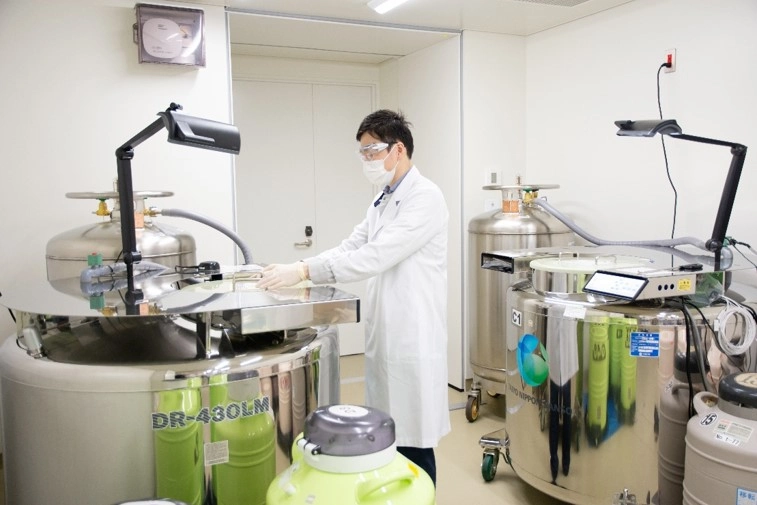
To reduce the use of natural resources, Sysmex has established production methods using silkworms and cultured cells for the production of animal-derived protein raw materials used in diagnostic reagents.
In the past, the production of these raw materials consumed a great deal of energy. However, silkworms can be raised indoors and require only artificial feed supplied in containers, contributing to a stable supply and consistent quality of raw materials. In addition to energy savings, this approach helps reduce environmental impact, including water consumption.
The coagulation reagents launched in fiscal 2017 use genetically modified proteins produced from silkworms as raw materials.
These reagents were the first in Japan to receive manufacturing and marketing approval as products using genetically modified proteins as raw materials. We are currently expanding the application of these raw materials to reagents marketed overseas.
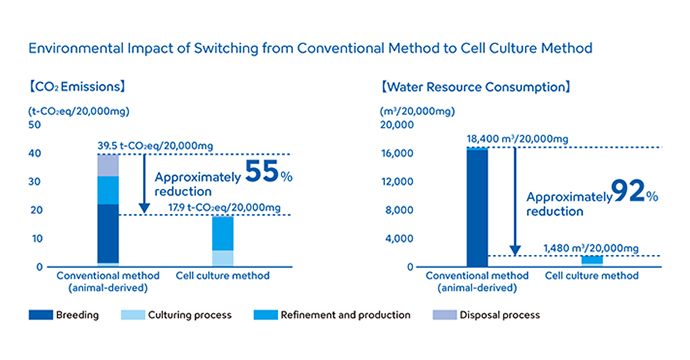
Through joint research with Professor Norihiro Itsubo of Tokyo City University (currently at Waseda University), we conducted a quantitative life cycle assessment (LCA) of this production method. Based on actual operational data over the seven-year period from fiscal 2017 to fiscal 2024, the assessment confirmed that, compared to producing an equivalent volume using conventional methods, this approach reduced CO₂ emissions by approximately 40% and water consumption by approximately 90%.
This initiative contributes to reducing environmental impacts, particularly carbon footprint, while also indirectly supporting biodiversity conservation by reducing the use of animal-derived raw materials. We are currently exploring the application of similar raw materials and production methods to other reagents, with the aim of expanding our product lineup with lower environmental impacts.
Environmental Considerations in Raw Material and Procurement Stages
Promoting Green Procurement
Sysmex has established the “Green Procurement Standards,” which set out the Companyʼs fundamental stance on environmental considerations in procurement activities. Guided by these standards, we promote the procurement of raw materials and parts with lower environmental impact while expanding our business with suppliers actively committed to environmental protection. We also conduct an annual CSR survey of suppliers to confirm that they have environmental management policies in place, as well as targets and plans for CO2 reduction and energy conservation.
At the procurement policy briefing in 2023, we introduced our Eco-Social Strategy. We also requested collaboration from suppliers on CO2 emissions reduction and various environmental measures, recognizing and rewarding suppliers that achieved outstanding progress in environmental improvements.
Furthermore, having obtained SBTi certification, we have established an engagement target to encourage suppliers to set their own greenhouse gas (GHG) reduction targets as part of our efforts to reduce Scope 3 emissions.
Toward achieving this engagement target, in fiscal 2024, we held a seminar for suppliers to share the importance of SBTi certification and target setting, as well as best practices in emission reductions. Approximately 130 suppliers participated in this session. In fiscal 2025, we provided training on CO₂ emissions calculation for suppliers and subsequently received calculated emission data from 51 companies.
Environmental Considerations in Product Transportation, Sales, and Services
Saving Resources by Reviewing Transport Packaging
Sysmex is advancing resource conservation and resource circulation through the redesign of its transport packaging.
In medical instrument packaging, we are transitioning from traditional wooden pallets and steel packaging to durable cardboard packaging. In fiscal 2025, we completed this transition for approximately 90% of our major products, achieving a reduction in packaging weight of around 70% and contributing to lower CO₂ emissions during transport. Simultaneously, packaging costs were reduced by approximately 75% per package, achieving both environmental impact reduction and cost savings.
We are also promoting a review of our transport materials. We are driving reductions in material consumption and waste through initiatives such as the following: adopting recycled-content stretch film (converting approximately 11 tons annually), introducing reusable foldable plastic containers and reusable cushioning materials to cut cardboard and other material use (reducing material consumption by roughly 57 tons), and reusing cooling materials in overseas transport (reducing waste by approximately 8.5 tons).
Through these initiatives, we are simultaneously reducing environmental impacts and improving operational efficiency while advancing the development of a more sustainable logistics system.
Complete Transition to Recyclable and Environmentally Friendly Materials
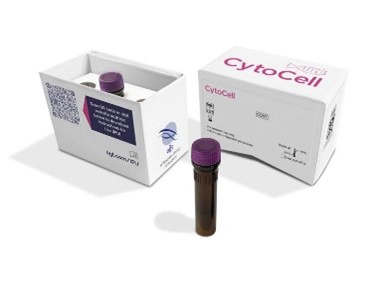
Sysmex is continuously working to substitute all materials used in product containers and packaging with recyclable and environmentally friendly alternatives. For product containers, we are transitioning to FSC-certified paper for reagent packaging boxes. For packaging materials, we are adopting cardboard made from recycled paper and FSC-certified paper while replacing vinyl cushioning with paper-based materials. In addition to these initiatives, in fiscal 2025 we replaced our transport packaging materials with those containing recycled content, increasing the utilization rate of environmentally friendly materials to 67% against our annual target of 65%. In fiscal 2026, we plan to replace plastic packaging materials for instruments with recycled-content alternatives.
Group companies are also advancing environmentally friendly product packaging. Oxford Gene Technology launched the Green Packaging Project, introducing new product packaging that achieves an approximate 97% reduction in plastic usage compared to conventional packaging.
Environmental Considerations in the Use and Disposal of Products
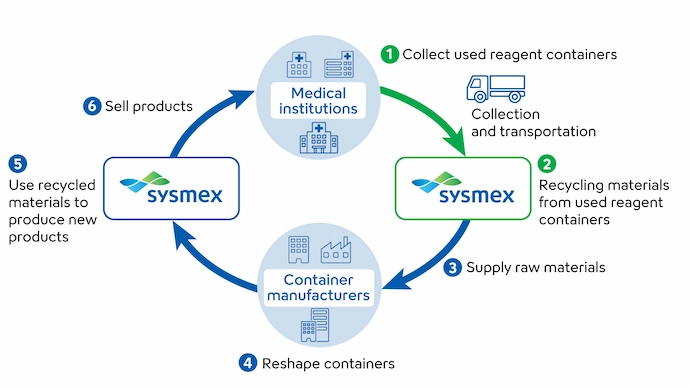
Industry-First Closed-Loop Recycling of Reagent Containers and Certification Under the Plastic Resource Circulation Act
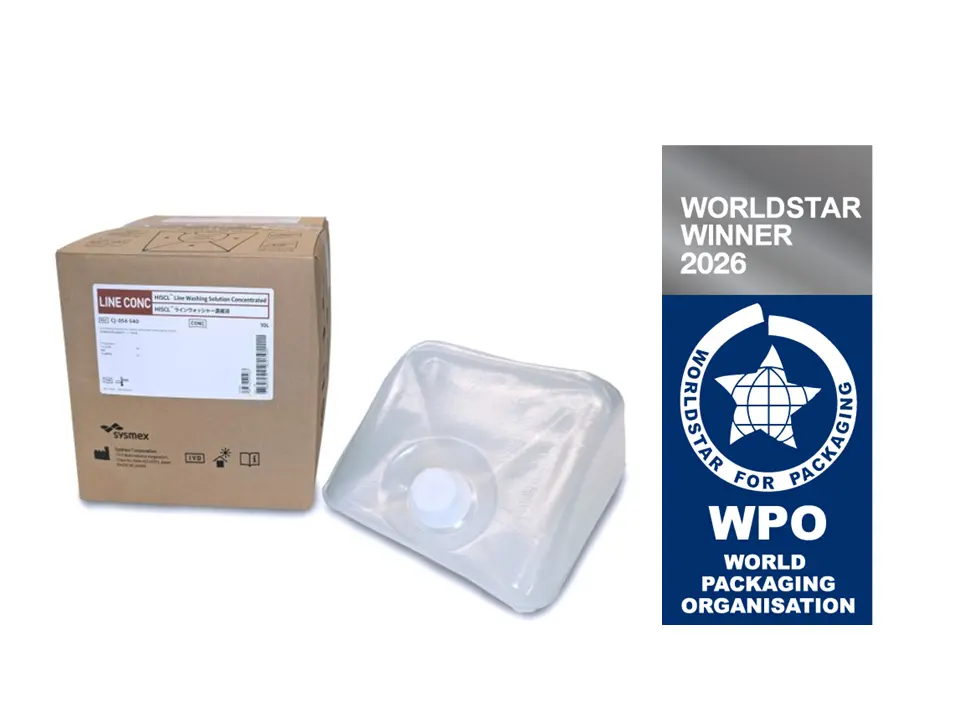
In January 2025, Sysmex became the first in the industry1 to begin closed-loop recycling2 of plastic reagent containers. While this had previously been considered difficult in the healthcare industry due to strict quality requirements, Sysmex secured recycled resins that meet medical-grade standards, thereby enabling used plastic reagent containers to be recycled back into raw materials. This initiative is expected to reduce the consumption of virgin resin used in containers (by approximately 30%) while lowering CO2 emissions associated with the disposal of used containers (by around 15 tons annually).3 In recognition of this advanced packaging solution that combines environmental sustainability with technological innovation, the initiative received international acclaim, winning a “WorldStar 2026 Award.”
In June 2025, Sysmex received certification for its business plan for “collection and recycling by manufacturers and retailers” under the Act on Promotion of Resource Circulation for Plastics. This certification eliminates the need to obtain industrial waste collection and transportation permits from individual local governments when collecting used plastic reagent containers from medical institutions nationwide. Under this certification, we collaborated with sales distributors to establish a collection framework from customers in the Tokyo Metropolitan area, initiating material recycling operations at our own factories in November 2025 to process collected containers into raw materials for closed-loop recycling.
- 1Based on Sysmex research
- 2A recycling method in which used products are processed into raw materials to manufacture the same type of product again
- 3Estimated by Sysmex based on manufacturer data indicating that incineration of a similar 160 g plastic container generates approximately 500 g of CO2. CO2 emissions were estimated by applying this emission factor to the volume of used containers generated by Sysmex.
Waste Reduction Through Product and Part Recycling
Since 2023, Sysmex has been selling replaced maintenance parts from analyzers as valuable resources instead of disposing of them as waste. In 2024, we expanded this initiative to include analyzers damaged during transport that could no longer be sold. Furthermore, in 2025, we broadened the scope to encompass expired reagents and consumables. As a result of these efforts, we achieved a waste reduction of 35.1 tons.1
- 1Calculated assuming all waste as plastic and using the industrial waste conversion factor set forth by the Ministry of the Environment
Reducing Environmental Impact and Improving Usability Through Concentrated Reagents
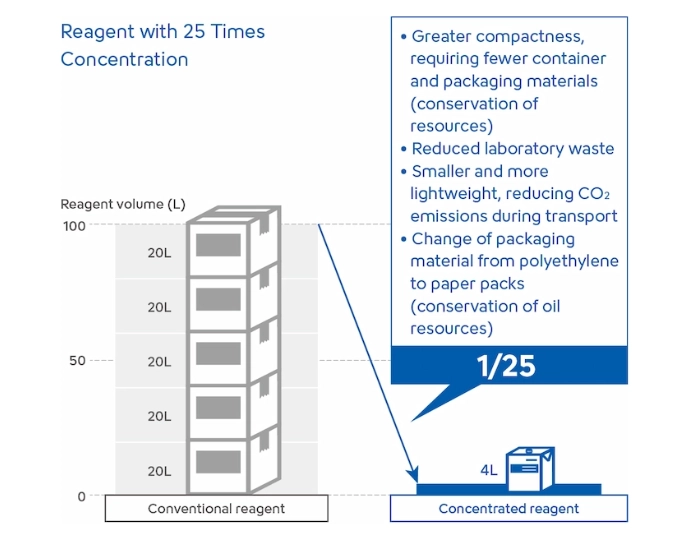
Sysmex has introduced reagents concentrated 25-fold compared with conventional reagents for some analyzers in the hematology field. Employing these concentrated reagents contributes significantly to improving usability by reducing the frequency of reagent replacement in laboratories and saving storage space. Additionally, adopting concentrated reagents achieves environmental benefits, including a reduction in waste from containers and packaging materials, as well as lower CO₂ emissions during transportation. This concentration technology has also been recognized through invention awards for its contribution to reducing transport volume and improving resource efficiency. We have set the adoption rate of concentrated reagents as a sustainability target and will work on initiatives to reduce the environmental impact.
Managing and Recycling Waste
Reducing Waste and Promoting a Stable Recycling Rate
Sysmex is continuously implementing initiatives to reduce waste and increase its recycling rates. At our R&D base, Technopark, we have installed polystyrene foam melting machines and large-scale shredders for confidential documents. Polystyrene foam generated on-site is converted into recycled plastic raw materials and sold as valuable resources. Additionally, shredded wastepaper is processed into toilet paper for reuse. In addition, we initiated an operational framework to sell scrap metal—including in-house instruments and obsolete freezers and refrigerators—as valuable resources, bringing the total volume of materials commercialized as valuable resources to approximately 63 tons in fiscal 2025.
In our domestic reagent production factories, we have promoted environmental initiatives in collaboration with suppliers to reduce waste from delivery packaging materials by replacing cardboard boxes with reusable returnable containers and revising excessive packaging.
Our domestic instrument production factories—i-Square, the Kakogawa Factory, and Sysmex RA—implement waste sorting processes for mixed plastic waste. In fiscal 2025, approximately 30 tons were sold as valuable resources, reducing overall waste volume by roughly 20% compared to the previous fiscal year. Furthermore, to decrease food waste from its in-house canteen, the Kakogawa Factory uses a specialized garbage disposal system to convert food waste into organic fertilizer, which is provided to local farmers. By purchasing agricultural produce grown with this fertilizer, Sysmex contributes to the realization of a circular society.
Promoting the Digitization of Documents
Sysmex is advancing paperless operations by promoting the electronic exchange of documents using personal computers, tablets, and smartphones. These efforts have reduced paper use and waste generation. In addition, at our manufacturing bases, we are promoting paperless operations by digitizing device history records and manuals.
Major Initiatives at Each Business Site
| Company | Initiative |
|---|---|
| Sysmex Corporation |
|
| Sysmex America |
|
| Sysmex Brazil |
|
| Sysmex Medica |
|
| Sysmex Asia Pacific |
|
| Sysmex Malaysia |
|
| Jinan Sysmex |
|