
Improving Accessibility to Healthcare
Today, global challenges that affect people’s health have become increasingly apparent, and international cooperation is essential for their resolution. Particularly in emerging and developing countries, people’s health is threatened not only by infectious diseases such as malaria and HIV but also by the lack of an adequate health system, leaving certain regions without access to proper medical care.
Sysmex is leveraging its core strengths in testing and diagnostics to address these challenges. By expanding access to quality testing in emerging and developing countries and helping establish diagnostic infrastructure that enables testing results to be interpreted according to common standards across countries, we aim to realize a society where as many people as possible can access proper medical care. Through these efforts, we seek to contribute to the achievement of Universal Health Coverage (UHC).1
Furthermore, to track our progress in improving access to healthcare, we have set sales in emerging and developing countries as a monitoring indicator for our sustainability targets.
- 1UHC: A condition in which all people have access to affordable and proper services to improve their health, prevent or treat illnesses, and recover
Contribution to Malaria Elimination
Transmitted by mosquitoes, malaria is one of three major infectious diseases defined by the World Health Organization (WHO) and is prevalent mainly in tropical and subtropical regions. Since malaria testing uses blood samples, Sysmex leveraged its technology accumulated in the field of hematology to develop an automated hematology analyzer that supports the standardization and optimization of malaria testing.
Malaria is a disease where the number of deaths can be reduced through early diagnosis and treatment. By introducing this product, which provides diagnostically useful testing results quickly and easily, into clinical settings, Sysmex is contributing to malaria elimination.
Realizing High-Precision and Simple Malaria Testing
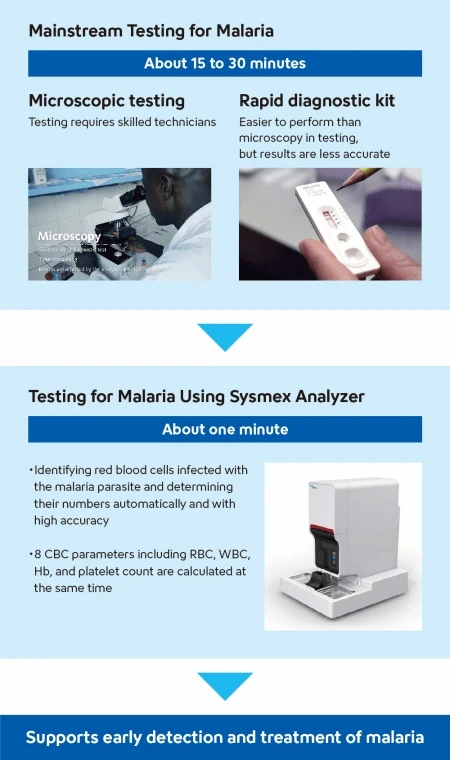
The current mainstream method of testing for malaria uses a rapid diagnostic kit or a microscope. However, both options pose problems such as the time required, ranging from 15 to 30 minutes, including pretreatment. In particular, microscopy requires highly skilled techniques.
In contrast, our hematology analyzer identifies red blood cells infected with the malaria parasite and determines the proportion of infected cells without pretreatment, automatically performing both processes in about one minute1 with a high degree of accuracy.2 In addition, since our hematology analyzer calculates eight CBC parameters3 that are measured at the same time in normal hematology testing, it can provide clinical settings with valuable data on conditions such as anemia, in addition to detecting malaria.
Through the use of this technology and product, Sysmex is committed to enhancing the quality of healthcare and supporting clinical settings in malaria-endemic regions, primarily in Africa.
- 1Time from sample loading to result determination.
- 2Testing by the analyzer does not mean that malaria diagnosis will replace microscopic testing. Nor does it mean a diagnosis can be made based on the outcome of analyzer testing alone. A definitive diagnosis is made based on the physician’s comprehensive judgment, which includes other clinical information.
- 3Red blood cell count (RBC), white blood cell count (WBC), hemoglobin concentration (Hb), hematocrit value (Ht), mean corpuscular volume (MCV), mean corpuscular hemoglobin (MCH), mean corpuscular hemoglobin concentration (MCHC), and platelet count (PLT).
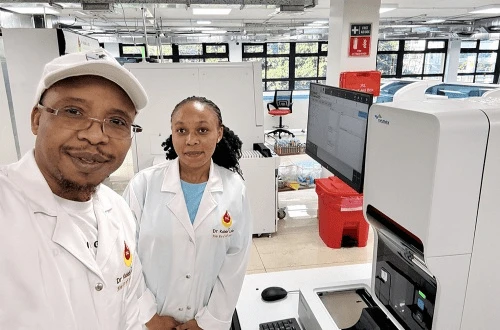
Interview with Healthcare Professional in Kenya
Sysmex’s analyzers enable malaria diagnosis with high sensitivity and precision in as little as one minute. They support treatment decisions in clinical settings through quantitative data on parasite load and complete blood count (CBC) parameters. Furthermore, automating the testing process reduces dependency on skilled microscopy personnel and improves diagnostic consistency. Furthermore, as someone working on the front lines of malaria control, I believe that establishing a diagnostic system capable of addressing infections even at an early stage or in cases where symptoms are not readily apparent is of great importance.
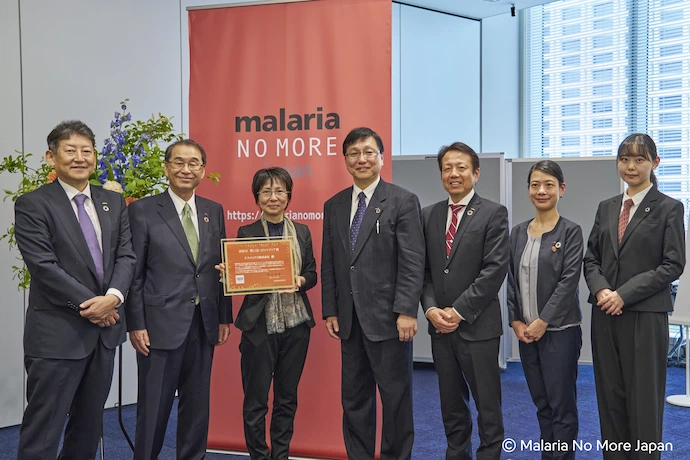
11th Zero Malaria Award Received
Sysmex Corporation was honored with the 11th Zero Malaria Award by the non-profit organization Malaria No More Japan, in recognition of its contribution to malaria elimination. This accolade highlights Sysmexʼs achievements in developing and disseminating innovative malaria diagnostic analyzers. Since its launch by Malaria No More Japan in 2014, this award has recognized individuals and organizations actively contributing to the international community’s goal of achieving zero malaria by 2030.
Ensuring and Maintaining Testing Environments to Support People Living with HIV
HIV (Human Immunodeficiency Virus) gradually impairs immune function over time, leading to AIDS (Acquired Immunodeficiency Syndrome) if left to progress. As of the end of 2024, approximately 40.8 million people worldwide were living with HIV, of whom around 31.6 million were receiving antiretroviral therapy (ART).1 In determining treatment strategies for people living with HIV and monitoring therapeutic effects, tests that measure the number and proportion of CD4+ lymphocytes (an indicator of immune status) play a crucial role.
In emerging and developing countries, Sysmex Partec continuously provides a testing system for CD4+ lymphocytes to assist in diagnosing HIV-infected individuals and monitoring their immune status. The system measures the number and proportion of CD4+ lymphocytes in the blood in just three minutes and is inexpensive, small, and portable, requiring only simple maintenance. Through these features, it aims to ensure everyone has equal access to simple, rapid, and stable testing.
In addition, this system has acquired prequalification2 by the WHO, accelerating its introduction in countries and regions in which medical resources are limited. This contributes to improving the quality of HIV diagnosis and care in emerging and developing countries.
- 1Source: Data published by UNAIDS (Joint United Nations Programme on HIV/AIDS) (2025)
- 2Certification system under which the WHO guarantees quality, safety and efficacy, with the aim of ensuring that health care products, including drugs, testing, and vaccines, can be used with a sense of security in countries lacking in resources. The system was launched in 2001 for drugs for HIV/AIDS and is now used as a reference list for procurement in emerging and developing countries. The Global Fund to Fight AIDS, Tuberculosis, Malaria, and other funding organizations preferentially choose products that have acquired prior approval.
Contributing to Diagnostic Infrastructure and International Standardization
To ensure access to high-quality healthcare, it is crucial that testing results can be interpreted using the same standards, regardless of where in the world the test is performed. In addition to addressing discrete diseases such as malaria and HIV, Sysmex is committed to developing the diagnostic infrastructure that underpins the reliability of testing results and advancing international standardization.
Advancing Testing Infrastructure Through the Establishment of International Standards
In clinical testing, it is essential that testing results can be interpreted using the same standards at any medical institution in any country. However, in blood tests (hematology field), the properties of blood change over time. This has made it difficult to unify standards using stable, long-term reference samples, presenting a challenge where testing results could not be easily compared across different countries or facilities.
To address this challenge, Sysmex has worked to establish reference measurement procedures that support standardization in the field of hematology. Recently, our reference measurement procedures for red and white blood cell counting, used in our reference measurement laboratories, have been registered with the JCTLM,1 a global framework that evaluates and registers measurement standards for clinical testing. This achievement was made possible through collaboration with national and international standardization and metrology organizations. As a result, these procedures have been recognized as internationally accepted reference methods and now serve as core technologies supporting standardization in the field of hematology.
Verification results based on the accuracy and operational structure of our globally established reference measurement laboratories were used as evidence demonstrating our competence and quality in the review for JCTLM registration. Furthermore, as this method has gained recognition as an international standard, it enables consistent comparison and evaluation of testing results across countries and facilities. This enhances the reliability of testing data provided in medical settings, leading to more accurate diagnoses and appropriate treatment decisions. This achievement represents an important milestone in advancing international standardization in the field of hematology.
Sysmex has been committed to maintaining and developing traceability frameworks for over 30 years. Going forward, we will leverage this expertise to consistently manage everything from standard establishment to clinical implementation, continuing to lead the development of international standards.
- 1Joint Committee on Traceability in Laboratory Medicine: An international organization that defines internationally harmonized measurement methods and reference materials in the field of clinical testing


Promoting International Standards to Enhance the Reliability of Testing Results
The quality of clinical testing is a critical foundation supporting the safety and reliability of healthcare. However, methods for evaluating test performance and managing quality vary by country and region, presenting challenges for consistency in comparing and interpreting testing results. Given this context, Japan is required to develop and implement test performance evaluation based on international standards.
To address this issue, Sysmex is working to improve the international consistency of clinical testing in Japan through the domestic adoption of international standards. Specifically, in collaboration with the Japanese Committee for Clinical Laboratory Standards (JCCLS) and the Japan Association of Clinical Reagents Industries (JACRI), we have developed verified Japanese translations of guidelines from the Clinical & Laboratory Standards Institute (CLSI). The first Japanese edition is scheduled to be published on the CLSI website beginning in July, with additional documents planned for publication sequentially in cooperation with relevant organizations.
These initiatives will encourage Japanese laboratories to adopt operations based on international standards, enhancing international consistency in test performance evaluation and quality control. Consequently, testing results obtained in Japan can be interpreted based on international standards, making it easier for physicians and researchers to compare data with overseas findings. This continuous accumulation of efforts will contribute to higher reliability in diagnostics and research decisions. Ultimately, using high-quality testing technologies established in Japan is expected to help improve the quality of healthcare worldwide.
We will continue to drive quality improvement in clinical testing through the promotion and implementation of international standards, contributing to a society where people around the world can access high-quality healthcare with peace of mind.
Contribution to Strengthening Health Systems
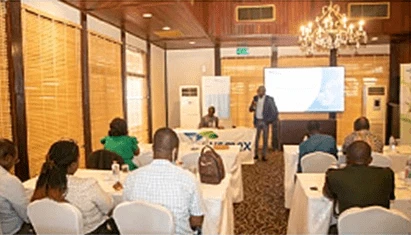
Emerging and developing countries need to develop the abilities of healthcare professionals (capacity building) to solve health and medical issues. Sysmex provides both in-person and online training on clinical value and instrument maintenance for sales distributors and healthcare professionals. Furthermore, we actively implement educational programs tailored to the unique needs of these countries, such as public-private partnership initiatives. Through these initiatives, we support the enhancement of knowledge and skills related to clinical testing, thereby contributing to the strengthening of testing systems and the advancement of health systems. Furthermore, the practical application of this acquired knowledge and skills in medical settings contributes to the early detection and treatment of diseases, as well as the delivery of more accurate diagnoses and appropriate treatment.
Acceptance of JICA Trainees
Since 1994, Sysmex Corporation has worked with JICA in providing training on the maintenance and management of its instruments, aiming to improve the knowledge and skills of healthcare professionals. To date, we have welcomed over 1,200 JICA trainees, contributing to the development of human resources in the healthcare sector of developing countries.
Strengthening Biomedical Engineering Education Through Public-Private Partnership with GIZ
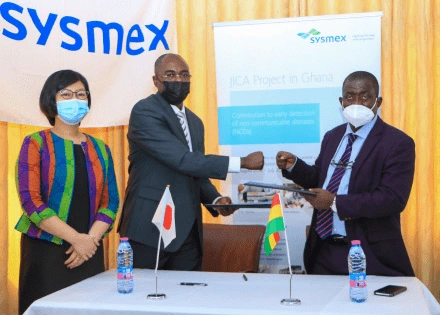
GIZ (Deutsche Gesellschaft für Internationale Zusammenarbeit) is a German government agency that implements international development cooperation on behalf of the German Federal Ministry for Economic Cooperation and Development (BMZ). As a private-sector partner in the GIZ-led public-private partnership program (develoPPP), Sysmex is participating in projects to strengthen biomedical engineering (BME) education in Kenya and Senegal (2018–2022) as well as Ghana (2023–2027). We contribute to local human resource development by providing medical devices, developing laboratory infrastructure, and modernizing and upgrading university curricula.
Supporting Quality Control and Standardization of Clinical Testing in Asian Countries
Sysmex has been continuously implementing support activities aimed at improving the quality and accuracy of clinical testing across Asian countries.
In Mongolia, in cooperation with Mongoliaʼs Ministry of Health, Sysmex provides support covering five testing fields (hematology, clinical chemistry, immunochemistry, hemostasis, and urinalysis). For facilities that face difficulties participating in external quality assessment (EQA) programs conducted in urban areas, we provide technical and academic expertise along with operational support to enable EQA implementation on a regional basis. Through these efforts, we are helping to enhance Mongoliaʼs healthcare standards by improving the quality of clinical testing.
In Cambodia, Sysmex is also promoting quality improvement in clinical testing through similar support related to EQA in the field of hematology.
In China, Sysmex’s hematology reference counter has been employed as a National Standard for Blood Cell Count1 since 2002. Based on this standard, registration inspections and EQA for hematology analyzers have been conducted throughout the country. In addition, Sysmex has continuously supported the technology transfer and technical exchange for reference measurement procedures for blood tests and the creation of national guidelines for clinical testing. Since fiscal 2019, we have leased the latest reference counters, contributing to improving the accuracy and standardization of hematology in China. Through these initiatives, we are driving quality improvement and standardization in clinical testing across Asia, thereby contributing to improved access to proper medical care.
- 1Analyzer used to assign reference values for the national hematology standard (red blood cell and white blood cell counts).
Malaria Control Support Using Counterpart Funds
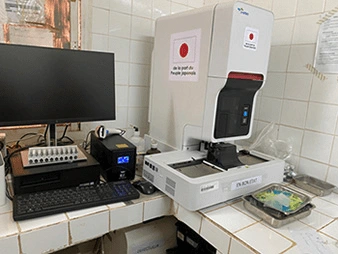
In 2024, using counterpart funds1 accumulated under a grant aid (food assistance) framework for Niger funded through Japanʼs Official Development Assistance (ODA), Sysmex installed malaria diagnostic instruments at Issaka Gazobi Maternity Hospital in Niamey and a regional hospital center in Tahoua. In conjunction with the installation, Sysmex provided training for local healthcare professionals on malaria and anemia management for malaria patients. Through these efforts, Sysmex has contributed to improving malaria and anemia countermeasures and providing appropriate treatment opportunities in the region.
- 1Counterpart funds refer to funds accumulated by the recipient countryʼs government through the local sale of goods and services procured under Japanʼs grant aid program. These funds are used for development projects in areas such as education, healthcare, and infrastructure, aimed at promoting the recipient countryʼs socio-economic growth, following consultations between the recipient government and the Government of Japan. The funds are managed by the recipient government, with reporting and audits conducted to ensure transparency.
Partnership
At present, developing countries need to develop their healthcare infrastructure to address medical challenges corresponding to each stage of economic development, and demand for healthcare services is expected to expand further. To deliver accurate testing results which serve as the gateway to healthcare and a prerequisite for treatment, Sysmex is building partnerships with health ministries, medical institutions, and other stakeholders. Furthermore, we are promoting institutional framework development and testing environment enhancements to popularize high-quality testing across countries and regions. In addition to leveraging international cooperation and public-private partnership frameworks, we also collaborate with other private companies, working to co-create new value that directly solves healthcare challenges.
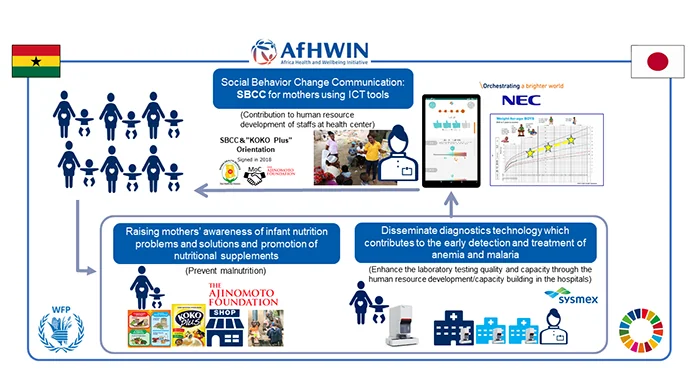
Cross-Industry Collaborative Co-Creation Project: Contributing to Universal Nutrition Health Coverage
In Ghana, serious healthcare problems include malnutrition—the greatest risk factor for death and disability—and malaria, which is the leading cause of death.1 Malnutrition causes stunting that delays physical and brain development in fetuses and infants, while also triggering anemia, which increases the risk of severe malaria. In addition, since children under the age of five years and pregnant women are highly vulnerable to the health impacts of malaria,2 an integrated approach that addresses nutrition, anemia, and malaria collectively is required.
From 2022 to 2024, Sysmex Corporation conducted a co-creation project aimed at improving maternal and child health and nutrition in Ghana in collaboration with the Ajinomoto Foundation and NEC Corporation. This project built upon initiatives previously advanced by the Ajinomoto Foundation in collaboration with the Ghana Health Service, such as promoting behavioral changes among mothers and recommending nutritional supplements. By combining high-quality testing with cutting-edge ICT originating in Japan, the project has established a system that contributes to improving maternal and child health and nutrition.
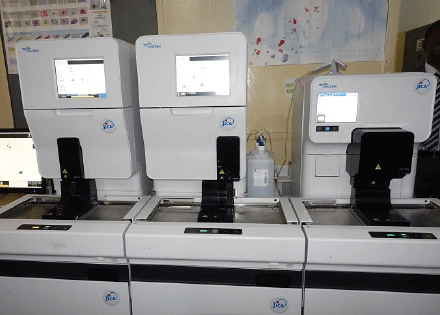
Beyond installing malaria diagnostic instruments at medical institutions, Sysmex contributed to strengthening the functions of regional hospitals through human resource development and awareness-raising activities for healthcare professionals. In addition, using data analyzed by malaria diagnostic instruments, we conducted joint research with the Ghana Health Service on the prevalence of anemia and malaria among pregnant women, mothers and their children, schoolchildren, and others in the project areas.
- 1The Institute for Health Metrics and Evaluation (IHME)
https://www.healthdata.org/ghanaOpen a new window - 2Children under five years old are particularly vulnerable to malaria and malnutrition. Malnourished children may develop more severe cases of malaria. Additionally, malaria increases the risk of poor outcomes for mothers and newborns, such as anemia and death in pregnant women, miscarriages, stillbirths, low-birthweight infants, and newborn and infant death.
Nutrition and Malaria: Integrated approach for effective case managementOpen a new window
Introducing a Colorectal Cancer Screening Program in Collaboration with the Egyptian Ministry of Health and Population
In recent years, aging populations, urbanization, and lifestyle changes across Africa have intensified the importance of addressing non-communicable diseases (NCDs) like cancer, alongside traditional infectious diseases. Because colorectal cancer often presents few initial symptoms and access to screening remains limited, diagnoses are frequently delayed. This underscores the urgent need for screening systems capable of detecting the disease before symptoms appear. Against this backdrop, Egypt has been standardizing and expanding a nationwide colorectal cancer screening program for individuals aged 40 and older under the leadership of the Ministry of Health and Population since 2023.
Under a public-private partnership framework, Sysmex Egypt worked to establish an operational system, spanning from sample collection to testing, while also engaging in public awareness campaigns. These initiatives have enabled the efficient, large-scale, and phased implementation of colorectal cancer screening, contributing to the promotion of early detection and treatment as well as expanding access to screening.
Exhibited at the Ninth Tokyo International Conference on African Development (TICAD9)
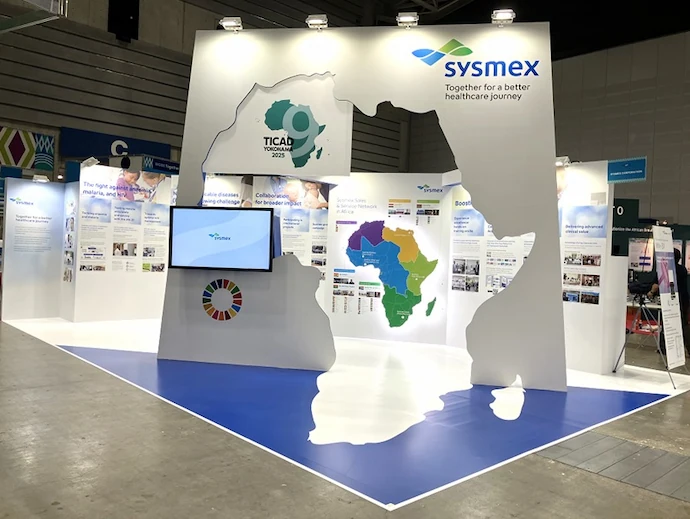
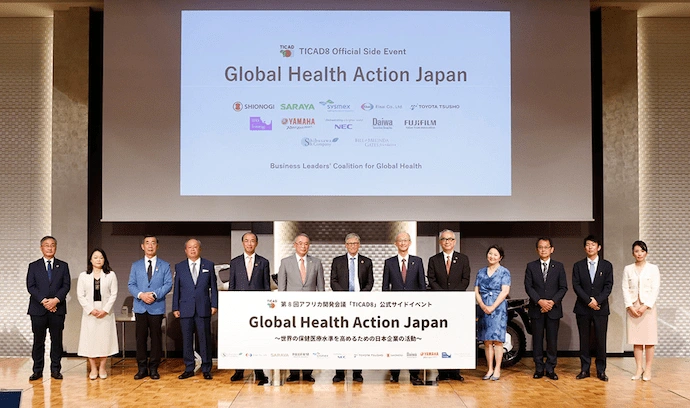
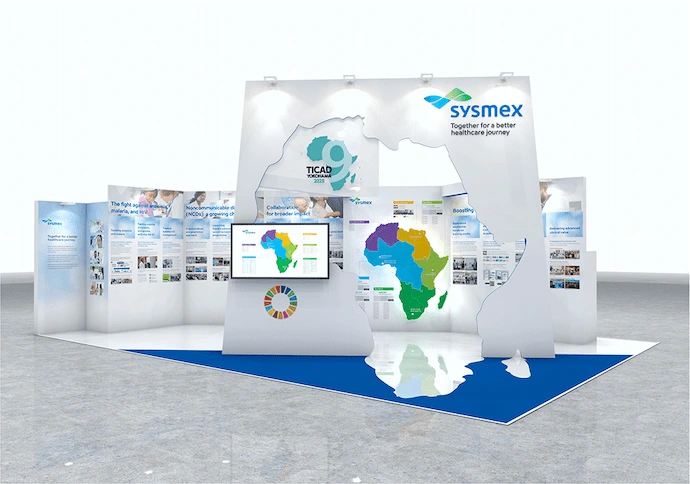
Sysmex exhibited at the Japan Fair, a side event of the Ninth Tokyo International Conference on African Development (TICAD9), held in Yokohama in August 2025.
Operating in approximately 50 out of the 54 African countries, Sysmex showcased its disease-specific approaches to healthcare challenges—such as anemia, infectious diseases like malaria and HIV, and non-communicable diseases like cancer—alongside its initiatives in healthcare workforce development and customer care structure. This exhibition provided a valuable opportunity to deepen dialogue and strengthen collaborations with stakeholders dedicated to solving healthcare challenges across the African region.