
Responding to Climate Change
Initiatives to Reduce Greenhouse Gas Emissions
Efforts to Reduce Greenhouse Gas Emissions at Business Sites
To reduce directly and indirectly generated greenhouse gas emissions, Sysmex is advancing the installation of energy-saving equipment, including high-efficiency air conditioning systems, LED lighting, motion sensors, and demand control systems that measure and monitor electricity consumption.
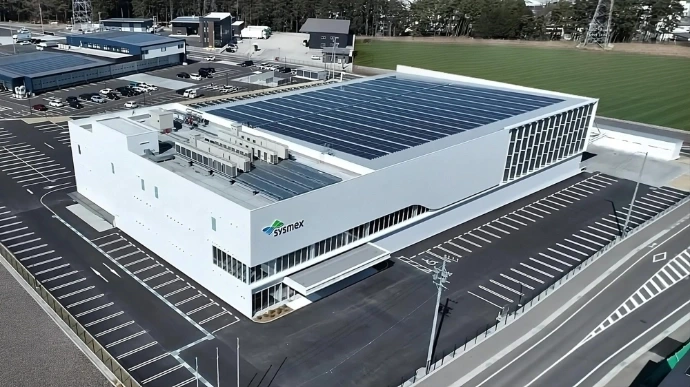
In fiscal 2023, the electricity used at major domestic facilities, including reagent production factories and R&D bases, was switched to electricity derived from renewable energy sources. Sysmex RA, one of the Groupʼs key factories, received Net Zero Energy Building (ZEB1) certification under the Building-Housing Energy-efficiency Labeling System (BELS2) for its new factory building, which commenced operations in April 2025.
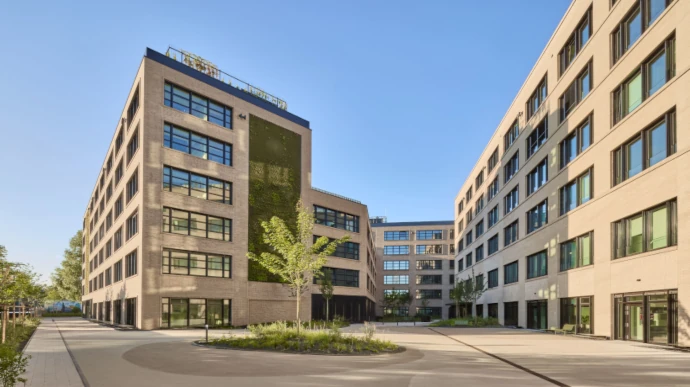
At Sysmex Europe, in connection with the relocation of its headquarters in fiscal 2025, the facility achieved LEED v4 Gold certification3 and established two designated nature conservation areas on-site. Its reagent production factory introduced ice thermal storage air conditioning systems4 alongside solar panels, covering approximately 35% of the energy required for reagent production. In addition, Sysmex business sites in EMEA5 and the Americas are progressively adopting electricity derived from renewable energy sources.
Sysmex America has formed a cross-departmental Green Team to promote environmental activities with a view to obtaining LEED certification for its headquarters site. It is pursuing ongoing initiatives to meet certification standards, including installing electric vehicle charging stations, upgrading LED lighting, and installing solar panels.
- 1ZEB (Net Zero Energy Building): A building that aims to achieve a net-zero annual primary energy balance by installing high-efficiency equipment systems to realize significant energy savings (energy conservation) while maintaining indoor environmental quality and generating renewable energy (energy creation)
- 2BELS (Building-Housing Energy-efficiency Labeling System): A building energy-efficiency labeling system established under the Act on the Improvement of Energy Consumption Performance of Buildings (Buildings Energy Efficiency Act)
- 3 LEED (Leadership in Energy and Environmental Design): A certification system that comprehensively evaluates the environmental performance of buildings from the viewpoints of reducing environmental impacts and promoting occupant health, including assessments of water-use efficiency, energy optimization, material resource conservation, and indoor air quality. The Gold certification referenced herein is based on LEED v4 Building Design and Construction: Core and Shell Development.
- 4Thermal energy storage technology using ice
- 5Europe, the Middle East, and Africa
Major Initiatives at Each Business Site
| Initiatives | Company | Details |
|---|---|---|
| Increase the efficiency of equipment and facilities | Sysmex Corporation | Switch to high-efficiency air conditioning and LED lighting. Increase productivity through a production optimization initiative. |
| Sysmex CNA | Use LEDs for all lighting. | |
| Sysmex Europe | Use LEDs for lighting in major reagent-filling rooms. Introduce motion sensors. | |
| Sysmex Asia Pacific | Use LEDs for lighting in factories and warehouses. Introduce a control panel that places instruments in standby mode to save energy when the air compressor is not in use. | |
| Sysmex India | Use LEDs for lighting in factories. | |
| Jinan Sysmex | Use natural gas boilers (switching from oil boilers). Switch from gas boilers to air-source heat pumps for winter space heating and purified raw water heating. | |
| Sysmex Wuxi | Save energy with restrictions to air conditioning temperature settings. | |
| Introduce renewable energy | Sysmex Corporation | Use electricity from renewable energy sources. Install solar panels. Save energy through the use of natural light (i-Square). |
| Sysmex America Sysmex Reagents America | Use electricity from renewable energy sources (all electricity). Introduce renewable natural gas. | |
| Sysmex Europe | Use electricity from renewable energy sources (all electricity). Install solar panels. | |
| Sysmex UK | Use electricity from renewable energy sources. Install solar panels. | |
| Jinan Sysmex | Install solar panels. | |
| Raise employee awareness | Sysmex Europe | Provide incentives for using trains for business trips; establish an in-house website for car sharing; provide bikes for commuting. |
| Sysmex Nordic | Cover the installation costs of home charging units to promote the transition to electric vehicles (EVs). | |
| Sysmex Malaysia | Provide incentives to employees who use hybrid vehicles for commuting. | |
| Sysmex Australia | Promote EV conversion for employee lease cars to support the shift to low-carbon mobility. | |
| Sysmex India | Ensure that all personal vehicles used by employees to commute are PUC certified.1 | |
| Sysmex Brazil | Switch to biofuel for company vehicles. |
- 1Acronym for “Pollution Under Control,” which certifies that vehicle emissions are below pollution regulation standards
Decreasing CO2 Emissions from Company Vehicles
To control fuel consumption and reduce CO2 emissions from its approximately 400 company vehicles in Japan, Sysmex Corporation has equipped all vehicles with dashcam-based telematics services. This allows us to visualize key indicators such as eco-driving practices and regulatory compliance for each vehicle, thereby enhancing the visibility of driving quality. We also conduct eco-driving training for all employees to improve the environmental awareness of individual drivers. In recognition of these activities, Sysmex received the Certificate of Excellence at the FY2024 Eco-Driving Activity Contest sponsored by the Foundation for Promoting Personal Mobility and Ecological Transportation. We are promoting the replacement of our company vehicles with more fuel-efficient vehicles. By the end of fiscal 2025, approximately 90% of all our vehicles had been converted to hybrid or fuel-efficient vehicles.
We are also accelerating the introduction of environmentally friendly vehicles and low-emission fuels across our global operations. Sysmex Brazil uses biofuels derived from sugarcane for its company vehicles and is expanding the use of electric vehicles for deliveries from its own warehouses to customers. Sysmex UK has eliminated diesel vehicles and replaced all company vehicles with hybrid models. Meanwhile, Sysmex Europe is driving the electrification of its company vehicles, with electric vehicles currently accounting for approximately 70% of its fleet.
Reducing CO2 Emissions Through Logistics Network Optimization
Sysmex recognizes the reduction of CO₂ emissions from logistics as a key priority and is promoting initiatives that combine the review of transport methods with the optimization of production, procurement, and logistics bases.
In terms of transportation, we are shifting to transport methods with lower environmental impact. Specifically, we are promoting modal shifts from air to ocean freight and from truck to rail transport, thereby reducing CO₂ emissions associated with transport.
In production and procurement, we are relocating reagent production bases while strengthening local sourcing and production frameworks. In Wuxi, China, we have established in-house production of reagent containers with complex structures through collaboration with local suppliers, replacing our previous reliance on external sources. This initiative has strengthened the local supply system while reducing CO₂ emissions by shortening transport distances.
Furthermore, in Japan, we established the East Japan Logistics Center in May 2026 to strengthen our stable supply system for reagent products. By consolidating deliveries to customers in eastern Japan at this center, we aim to shorten supply lead times and enhance logistics efficiency while optimizing transport distances to contribute to CO₂ emission reductions.
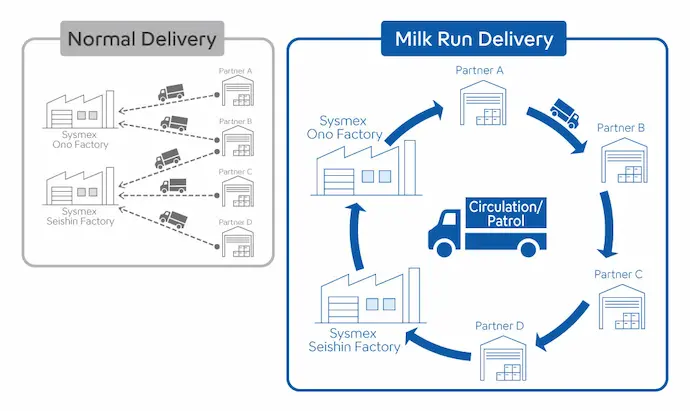
Additionally, for transporting reagent raw materials and instrument parts, we have introduced a “milk run method,” whereby a single vehicle visits multiple suppliers to collect and deliver these materials.
This consolidates transport and increases efficiency in vehicle operations to achieve CO₂ reductions. In fiscal 2025, we expanded the coverage areas and participating partners to further refine and advance this initiative.
CO2 Reduction with Dry-Ice-Free and Consolidated Cargo Transportation
Sysmex previously used dry ice to transport reagents for genetic testing and quality control materials for clinical chemistry testing, which require strict quality and temperature control. However, the use of dry ice poses challenges including environmental impacts from CO₂ emissions, as well as supply instability and rising prices in recent years. Careful handling is also required to address safety risks, including frostbite caused by ultralow temperatures and oxygen deficiency resulting from the buildup of carbon dioxide.
To address these challenges, in 2021, we partnered with Yamato Transport Co., Ltd. to establish dry-ice-free consolidated transportation for reagents for genetic testing at ultralow temperatures below −70°C. Since 2022, in partnership with a major distributor in Japan, we have also provided completely dry-ice-free transportation for quality control materials for clinical chemistry testing to more than 300 customer facilities.
Furthermore, in 2026, we developed dedicated shipping containers for small-volume deliveries and began expanding dry-ice-free transportation to a broader range of customers. We will continue expanding this initiative nationwide, aiming to reduce dry ice use in the transportation of major frozen products by at least 80% by fiscal 2028 compared with fiscal 2021. By reducing environmental impacts and our dependence on dry ice in logistics, we aim to mitigate supply risks, improve transportation safety, and build a sustainable logistics system that supports the stable supply of diagnostic reagents.
Initiatives at Group Companies: Collaboration with Logistics Partners Considering the Environment
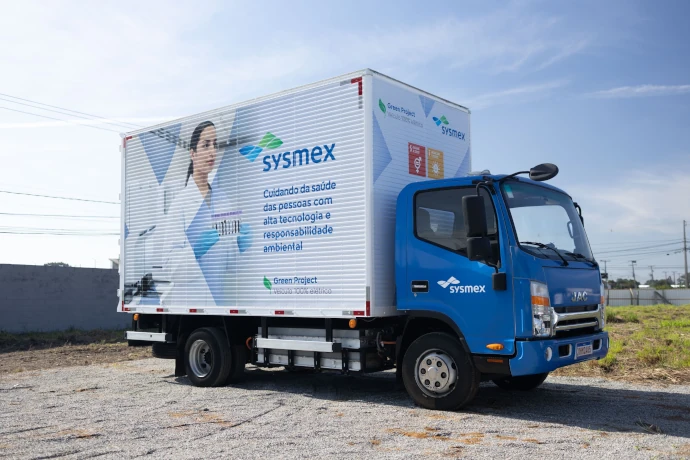
Sysmex Brazil, in collaboration with its logistics partners, has introduced the first electric trucks in the Americas region. These vehicles are used not only to deliver reagents to customers and sales distributors but also to transport products between warehouses and factories, supporting the decarbonization of logistics operations. Meanwhile, Sysmex Nordic is partnering with industry associations and customers to explore strategies for reducing transport distances and shipment frequencies to lower logistics-related CO₂ emissions. In addition, Sysmex Europe has incorporated environmental criteria into its distribution partner selection process, including certification under environmental management systems and the use of green logistics practices. Sysmex Malaysia uses reusable vacuum-insulated boxes for the transport of temperature-sensitive products, achieving CO₂ reductions through energy savings while decreasing waste from polystyrene foam boxes.
| Company | Initiatives |
|---|---|
| Sysmex Reagents America |
|
| Sysmex Europe Other affiliates in the EMEA region |
|
| Sysmex Malaysia |
|
| Sysmex Australia |
|
Environmental Considerations in Product Training
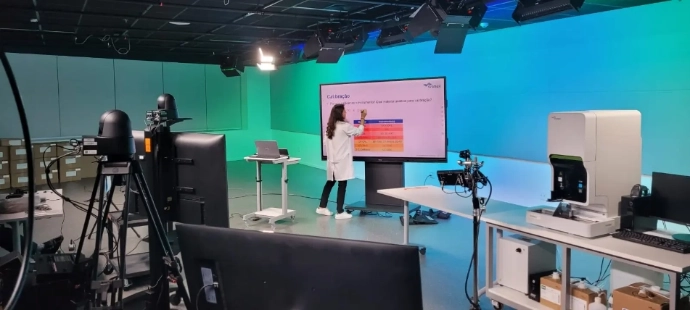
Sysmex is working to reduce CO2 emissions associated with participant travel by developing and expanding environments that enable user training on instrument operation and maintenance, as well as scientific seminars, to be conducted online in regions around the world. In addition to e-learning, which enables customers to acquire skills anytime and anywhere at their convenience, we provide highly immersive virtual training through fully equipped online studios. This allows customers, even in regions far from training centers, to receive standardized, high-quality product training.
Furthermore, we offer virtual training programs for technical service and application support personnel from both Sysmex and its distributors to acquire specialized product skills. By leveraging online training in this manner, we are promoting both high customer satisfaction and the reduction of CO2 emissions.