
Choosing for Oneself and Being Chosen: Transforming the Assignment Process for New Graduate Employees through Job Matching

At Sysmex, human resources are a key management resources that support sustainable growth, and we regard human capital as the source of corporate value creation. In addition, Sysmex is committed to improving employee engagement, based on its corporate philosophy of “Shared Values,” which states that we provide an environment where all people working at Sysmex can feel secure in demonstrating their abilities and opportunities for self-realization and growth.
Sysmex believes that career autonomy, in which employees take initiative to design their own career path rather than leaving it up to the company, is essential to improve employee engagement, and that employees must have the opportunity to choose their own careers. From 2021, we introduced a new system that uses a proprietary algorithm developed in collaboration with the University of Tokyo Market Design Center (UTMD). The system is designed to determine the optimal “match” (plan for assignment) for which department the new graduate should be assigned based on the requirements of new graduates and departments that are candidates for the new employees’ assignment, with minimal intervention from the human resources department.
In this article, we introduce an overview of Sysmex’s job matching program and the background behind its implementation.
Utilizing Matching Theory for Personnel Assignments to Promote Autonomous Career Development and Engagement
For many years, Sysmex has managed its human resources through the so-called Japanese-style (membership-based) personnel system, in which the company decides an employee’s assignment and promotion decisions. However, with the rapid globalization and portfolio expansion of our business, the ratio of mid-career hires and non-Japanese employees has increased year by year. In order to sustain our high growth potential, we urgently needed to acquire and train highly specialized personnel and next-generation leaders, as well as appropriately assign and train diverse human resources and create an attractive environment for them to succeed in.
In 2020, we introduced a new job-based personnel system as one of the foundations to enable each employee to develop their expertise and design their autonomous career path. This new system revolutionized the former ability-based personnel system in which employees’ grades are ranked based on their ability, by determining an employee’s grade based on their role and job content.
Employees and Departments Show Each Other’s Appealing Points which Encourages Employees’ Autonomous Growth
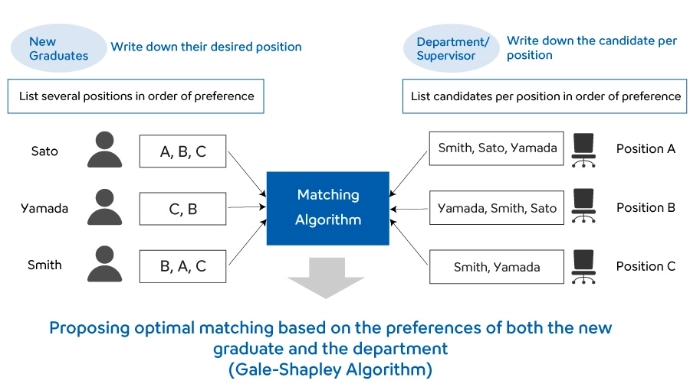
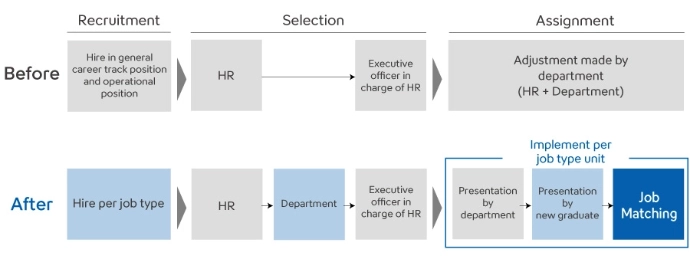
To introduce the matching algorithm, we first reviewed Sysmex’s recruitment flow for new graduates. Instead of dividing jobs into the two main categories: general career track positions with opportunities to assume managerial responsibilities versus operational positions limited to clerical duties we established contact points for each job type from the time of recruitment. In addition, during the initial training period after the employee enters the company, each department that is a candidate for the new employee’s assignment will give a presentation to introduce its department’s mission and job content. Next, the new graduate gives a presentation to showcase itself. After both sides complete their presentations, the new graduate ranks its preferred departments, along with each department also ranking the new graduates in its order of preference. This information is then entered into a matching algorithm to determine the department the new graduate will be assigned to.
In the first year the new decision process for job assignment was implemented (FY2021), the ratio of satisfaction among new graduates was 95%, and 71% for engagement score, up nearly five points compared to the previous year.
In addition, the ratio of new graduates who had no intention of transferring to another department also increased from 64.4% to 85.7% compared to the previous year. These results indicate that the increased transparency of the placement process—and the use of a system that allows both new graduates and departments to express their preferences—has led to greater satisfaction with assignment decisions.
Meanwhile, the satisfaction rate of the departments accepting new graduates remained at around 70% in the first year, with some departments feeling disappointed over the limited number of new graduates expressing a desire to work with them. However, from the next year onward, departments started making an effort to convey their own allure. They began seeking ways to appeal their department enough to be chosen by new graduates, emphasizing the fulfillment in their work, the type of work new graduates will experience, and the skills they will acquire in the future. The new graduates also began to actively engage in the process, asking a series of specific questions after the departments’ presentations, imagining what it would be like to work there.
This has increased both parties’ satisfaction with assignments, and in FY2022, the three-year turnover rate for new graduates was 0%, while the company’s overall turnover rate was 2.7%. So, we were able to achieve our target of less than 3.0%. In follow-up interviews with new employees, we have seen firsthand how they are much more motivated to work than in the past.
Opening Opportunities and Giving More Employees the Experience to Design Their Own Career
Matching algorithms do not solve all career development and engagement challenges. In fact, even if you are assigned to the department of your first choice, after some time you may find it does not match your values and strengths. In such cases, we have a system in place in which open positions are made available to the entire company so that employees can apply for them. There have been cases where employees changed their job title from sales to planning, or from development to human resources, or some employees in their 40s have even taken on the challenge of overseas-related work which they had long hoped for. These opportunities are not limited to younger employees—they are helping a wide range of individuals take ownership of their careers.
Sysmex actively supports the autonomous career development of each and every employee. The ability to build a career of one’s choice in accordance with one’s life stage and career values leads to employees being able to work with happiness. Sysmex believes this will result in high productivity and added value and will help realize becoming a company that continues to grow.
To realize our long-term vision, “Together for a better healthcare journey,” Sysmex will continue to promote aiming to become an organization where diverse human resources can feel comfortable exercising their abilities and creating innovation.
(2026.02.09 updated)


